

An artist searches for their place in society
Hany Rashed’s baby sister died in his arms. He still recalls the moment vividly, saying: “Suddenly, she urinated and her face turned blue. I was sixteen years old, and my father was at the hospital suffering from a heart attack. I was running in the streets, screaming and asking people for help.” Rashed found himself obliged to perform all the funerary rituals and bury his little sister who had been born suffering from respiratory problems, and to whom he had already grown deeply attached. During the burial, he cut a little lock of his sister’s hair and to keep with him in his wallet. After the painful event, Hany began to suffer from severe depression. He had a recurring nightmare in which he was running through the streets searching for someone to help him, but no one heard him, no one saw him, and no one came to his aid. He confined himself to his room, shutting the door and refusing to talk to or interact with anyone. His father’s friends advised him to find his son a job, arguing that if he went out to work he would have to deal with people and would gradually recover.
His father succeeded in getting Rashed assigned to a post at Maspero, the national television and radio headquarters, where he worked. Inside the enormous building, home to one of the most labyrinthine of government bureaucracies, Hany found himself at the bottom of the employee food chain. All forty-thousand Maspero employees are positioned within a hierarchal system that reflects the logic of Egyptian social strata. At the top are the photographers with university qualifications, followed by the assistant photographers, the technicians, and the assistant technicians with college degrees. At the bottom rung are employees without any advanced degrees. Rashed, who joined the staff while still studying electronics at a technical high school, entered at the lowest level. As before, he remained taciturn and reluctant to interact with others. Instead, he found dozens of discarded sheets of paper in the TV studios, and began drawing during the downtime he had between long work shifts. Most of the photographers employed at Maspero were graduates of the Faculty of Applied Arts; they noticed the drawings and began encouraging him.
Samia El Etreby-at the time, a TV anchor specializing in cultural programing-counted amongst these admirers. In one episode, she hosted the artist Mohamed Abla and showed him Rashed’s drawings. Abla liked them, and wrote his phone number in the margin of one of the drawings: an open invitation. Subsequently, Rashed visited Abla and recounted the story of the death of his sister, saying that he chose to draw as a means of compensating for his loss and escaping his sorrows. Abla thought his drawings deserved to be displayed. At the same time, he told Rashed that he was experiencing something that might produce a strong exhibition but not necessarily qualify him as a serious artist.
In 1995, and with Abla’s support, the Cairo Atelier hosted Rashed’s first solo exhibition. He was ecstatic at the invitation card and a paper bearing the title “artist” next to his name. The Atelier staff assigned prices to his work without consulting him, despite which, none of his paintings sold. Rashed was dismayed: What was the use of being an artist if you cannot sell your art? He tore the prices off the paintings. He visited Abla, declaring that he felt like a phony. He painted and held exhibitions, yet without selling any of his work, he was not an artist. Abla tried to convince him that that was not true, that art has various paths, and that the market constitutes a world of its own, with different rules, which he could not enter except by searching for his own personal style and identity as an artist.
***
Amr ElKafrawy studied art at the Faculty of Fine Arts for four years and graduated with the aim of obtaining a membership in the Fine Artists Syndicate. His membership in the Syndicate guarantees his status as an artist in official government papers. It took Elkafrawy years to forge his own distinctive style. He volunteered for awhile with the artist Abdel al-Hady al-Weshahy. Ultimately, however, he chose printmaking and book-cover design in order to achieve a degree of financial independence to provide for himself and his art. Elkafrawy embarked on a long journey of discovery; he depended on observation, travel, and reading in search of his own, distinctive style, far removed from academic studies.
Inside the galleries of the Fine Arts Sector, staff employ the title of “doctor” when addressing any artist. Elkafrawy does not possess a PhD, but he says that when he answers the phone and the caller addresses him as “doctor,” he knows that the phone call is from someone at the Ministry of Culture. The relationship between academic credentials and one’s status as an artist dates to the period after the 1952 Revolution, when policy reforms helped professionalize the role, linking it to a series of state institutions. In the 1960s, an extensive series of procedures were instituted with the aim of integrating artists into the new “post-revolutionary” social system. The Ministry of Culture was established in 1958 and government institutions took on the mantle of arts patronage and artists inside the Ministry, within the framework of using art in the dissemination of the new values adopted by the July regime. Under President Gamal Abdel Nasser, the art sphere was structured in accordance with strict legal and bureaucratic prerogatives including the stipulation that the Fine Artists Syndicate would not grant membership to anyone lacking sufficient academic qualifications. To this day, when the state evaluates artists, it does so in accordance with the degrees that they have obtained at the state institutions specifically established for that purpose. As a result, it has been impossible for Rashed to obtain the membership of the Fine Arts Syndicate, even after the revolution in 2011, which resulted in demands for a reform of the cultural sector, among others. With only a diploma from a technical high school, he simply remains outside of the categories of artists recognized by the state, just as in Maspero, where his preparatory school certificate barred him from entering the ranks of “true” employees. An artist who wants to realize his potential and establish a position for himself in society has two choices: he must strive for social recognition through study or through the market.
Rashed spent many years dividing his time between working at Maspero, training in Abla’s studio, hanging paintings and cleaning Mashrabia Gallery, and, finally, grabbing a few hours for his own painting, until one evening, when he accidentally emptied the contents of his wallet on the stairs while returning home drunk. The next day, he recovered everything he had lost except the lock of his sister’s hair, which he had kept in his wallet for years. After the incident, he stopped painting, feeling that he had lost his good luck charm. Later, while on a visit to his family in the countryside he met an old, white-bearded man, and recalled the story of the lost lock. The man offered an interpretation of his story saying: “When your sister died she left you her luck in life, and her lock of hair was your good luck charm. It opened the way for your painting and art. Now that your sister has taken luck from you again, the choice is yours, either you continue along the path that your sister opened for you, or you close that door.”
After the incident, Rashed returned to painting, and was awarded the Youth Salon Prize. In 2011, Mashrabia Gallery hosted a solo exhibition, and, unexpectedly, more than half his paintings and art pieces sold. He felt then that he had gained access to the world of art. Following the exhibition, he received numerous offers to display his work in other galleries in Egypt and around the world.
The artist and truth
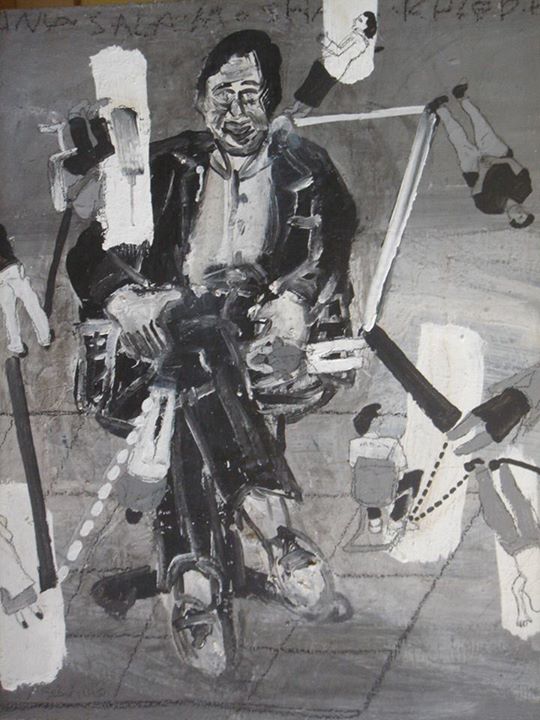
In 2008, Rashed took a leave of absence from his work as a television technician, and eventually resigned in 2010. His experience working at the state media center was the subject of one of his exhibitions, entitled “Maspero.” Despite his insistence on maintaining clear borders between his various jobs, his work in other areas often infiltrated his artistic practice, possibly even leading him towards new and different artistic paths.
Due to the weak infrastructure of the art market in Egypt, many artists are forced to take up jobs only marginally related to artistic practice following graduation. The Egyptian artist has at their disposal a celebrated expression based on the distinction between “sculpture” (naht) and “art” (fann). “Sculpture” is the term used to signify art-related work that the artist practices to secure an income and savings, and pursue their artistic practice, or “art”.” proper. Some artists are able to achieve this delicate balance, while others become so engrossed in “sculpture” that they forget their art or find that their aspirations fade under the constant pressures of everyday life.
Bassem Yousri’s story offers a third model of a career path available to artists. Following his graduation from the Faculty of Fine Arts in 2003, Yousri worked as a specialist in fashion and print design at the Mobaco Company for Fashion Design. After more than two years, he had acquired many practical skills, the most important of which were computer skills and printing techniques. His work experience and qualifications helped him to win a scholarship from the Fulbright Program: an international educational exchange initiative funded by the U.S. government. The scholarship included a few months of advanced study in art and fashion design, with the provision that, at the end of the fellowship, Yousri would hold an exhibition combining photography and clothing design.
After completing the Fulbright, Yousri obtained another scholarship to complete his art studies at the Kala Art Institute in California. While, up to this point, he had focused primarily on photography and painting, Yousri found himself increasingly interested in video art. This interest transformed into a more comprehensive approach to art, or as a work or a dialogue grounded in the site in which its displayed, rather than reducing “art” to a painting confined to the limits of a frame.
Yousri refuses to become a “market artist” (fannan suq) who caters to the needs of collectors. He asserts that the market consumes art and dissipates the true meaning of a work, eventually, making the artist forfeit his “truthfulness” (sidq), or the main value of a work of art. He describes his work, saying: “I try to present ideas and art forms that challenge the recipient and spectator, not to upset him, as I see that as disrespectful, yet, at the same time, to provoke him and challenge his values and ideas regarding beauty and art. Thus, I do not produce works of art that are easy to sell.”
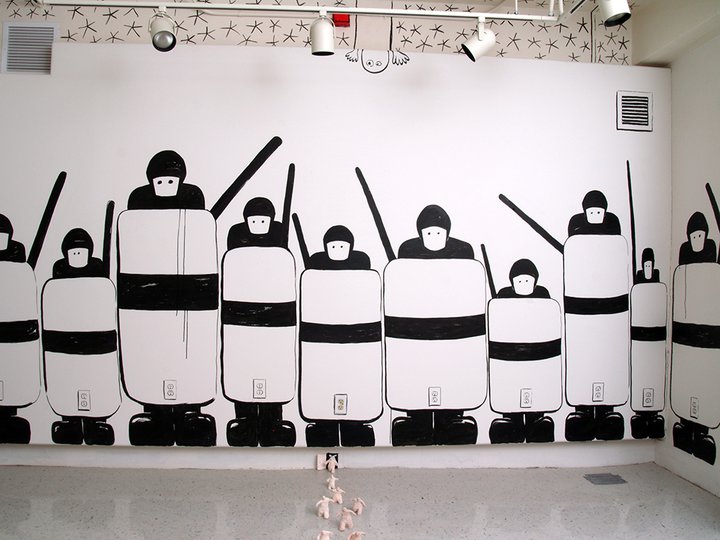
Homage to the Egyptian Revolution - Bassem Yousri -Installation done at Kansas State University during my residency there as a visiting artist.- Acrylic ink on wall and white stoneware figurines. - March 2011
Repetition is central to Yousri’s work. Similarity and duplication are among the themes he plays upon in his exhibition “Homage to the Egyptian Revolution, 1 Installation,” held at Kansas University during a residency scholarship that he received in March 2011.. For the event Yousri produced numerous small statues trapped inside the walls of the white cube alongside drawings of Egyptian sometime riot police, or Central Security Forces. Yousri does not sell installations in their entirety, though, he might sell one of the smaller sculptures comprising these works; ultimately this does not affect the work of art as a whole.
He stopped working full-time at companies after 2011. Sometimes, he takes on translation projects to supplement his income, and depends on the offers that come to him to hold art exhibitions in Egypt and abroad. Yousri believes the aim of all his endeavors is to live as an “artist,” without being a “market artist.” At the same time, he recognizes that his work is implicated in the conditions of contemporary artistic production in which museums and art spaces finance the production of new works rather than commercial galleries, freeing the artist from the pressures and fluctuations of the market. Artists who survive off the sale of their work live in a state of constant anxiety: awaiting the opening of an exhibition, worrying about public attendance, and whether or not the work will appeal to potential buyers. Artists who operate outside of this context enjoy a relative feeling of security, as the work, and even artist’s fees, are usually financed before the opening of the exhibition. While, acknowledging that this sense of security is accompanied by certain constraints, Youri’s first priority remains his ability to preserve what he calls his truthfulness: “I do not have any problem with exhibiting my work anywhere. The only condition I have is that I control all the details of the presentation and control the authenticity of what I exhibit.”
“Truth” represents a relative and elusive value in the art world. Unlike Yousri, Rashed believes that the artist relinquishes their truthfulness and independence when they become complicit in the mechanisms of foreign financing and support of art projects. This funding creates an alternative to the market: a system of production, which, in the Egyptian context, is dominated by Western entities.
One of the factors distinguishing the market and its alternative in foreign funding is the role of the curator, or their relationship to the artist. Yousri is not opposed to working with curators. He views the latter as akin to a film director in that he or she selects the artists they want to work with and channels their work towards the production of a single work as if is directing a film, or an art exhibition. In contrast, Rashed, immersed the laws of the commercial market, has had negative experiences with curators. He finds their involvement a source of stress and a violation of his independence as an artist, while reminding him of his days receiving orders as a low-level employee at Maspero. One of his worst artistic experience, Rashed recalls, was when he was invited to an exhibition in Germany dedicated to the theme of the Pharaonic ankh, or “key of life.” He found the project’s premise lackluster and tired, and, subsequently, decided not to participate in any work of this type in order to preserve his artistic independence and to remain true to himself.
Another factor is the role of the gallery. Whereas Yousri identifies institutional support as tied to the production rather than sale of works, Rashed has his own take on venues such as the Townhouse in downtown Cairo, and other exhibition spaces that do not specialize in selling art. The reason for this, simply put, he states is: “If an artist does not sell his work, how is he supposed to live and continue to survive and produce more work?”
Of course, the market “alternative” does not operate independently of the wider political and ideological landscape. The painter Adel El Siwi recalls, for instance, how Western interest in Egyptian and Arab art boomed after September 11, 2011; many art exhibitions were organized to introduce Egyptian artists and present their work to audiences abroad. This trend was concurrent with exhibitions organized under such titles as “The Other” or “Dialogues Between Cultures” among other titles and themes that were in vogue as a result of the political events following 9/11.
The market as an art school
The market represents a sensitive topic for young artists, some of whom wish to engage it while preserving their independence, while others produce works of art that go against established market rules. El Siwi, who belongs to an older generation of artists, appears more at ease in dealing with market issues, which he describes as a tool of dual-identity making in that it creates works of art that are both divisible and distributable in nature. The market gave birth to the easel painting, El Siwi argues, and is, in its essence, a serious and revolutionary concern.
Born in 1952, El Siwi graduated with a degree in Medicine from Cairo University in 1976, and quit soon after to concentrate on studying art. He moved to Milan, where he lived from 1980 until 1990, when he returned to Cairo. In Italy, he glimpsed the historical roots of artistic practice as they exist today; he observed the way in which art had created its own institutions throughout history to deal with the market’s various needs. He recounts that there exists a century-long model of artistic production in Milan tied to “artistic corporations” (kombaniyat faniyya) that represent an admixture of companies and cooperative syndicates. Collectors contracted with a corporation, which provided artists to execute the commissioned work of art according to the collector’s wishes.
El Siwi dabbles in the market, while remaining alert to its moods and fluctuations. An artist should remain atuned to the market, he asserts, without succumbing to its demands, so as not to alienate themselves from their own work: making it repetitive, or fixing it in an image which the artist believes is demanded of it.
At the same time, El Siwi believes that an artist should not ignore the market. He recalled, one instance, in which he received a telephone call from a lady who wished to commission two works measuring one meter across and three meters high, to ornament two pillars standing at the entrance to her house. El Siwi politely declined the offer, despite the fact that he had taken on commissions in the past including a large-scale mural located in the lobby of the Semiramis Hotel, made up of many elements from paintings displayed in his exhibition “Stars of Our Age.” Nevertheless, two days later, El Siwi sat, contemplating how he might go about making a painting that measured one by three meters, and how to approach vertical space. Eventually, he decided to experiment with the constraints, and finding the results acceptable, he called the potential client back, and discovered that she was the wife of pop star Amr Diab, and that the art work requested of him was for the singer’s house.
Early in life, El Siwi worked with the artist Hassan Soliman. He claims that the latter had a philosophy, which he summarized in one phrase: “Work a lot, sell cheap, and you will earn a lot.” This is the same phrase that Hany Rashed judges to be his cardinal rule in dealing with the market. Yet, Rashed refuses to work on consignment or to execute work in specified places. His point of view is that if an artist succumbs to all market pressures and considerations he will find himself outside the market game: “Art is a fashion and the artist must change the market. If you follow what is demanded of you, you will always remain one step behind.” Nevertheless, experimentation comes with its own risks.
Rashed held an exhibition at Mashrabia in 2013 entitled “Asa7by” which borrowed a widely popular Internet meme of the period (a cartoonish drawing of a laughing face), integrated into the exhibition alongside other popular visual tropes. The exhibition was not favorably received by many art collectors, and Rashed did not sell any works. Nevertheless, he continued to develop the experiment, and it appeared in a different guise in an exhibition entitled “Made in China,” also held at Mashrabia Gallery in 2014. He displayed pieces of plastic which he painted on directly, and which were exposed subsequently to hot air so that the plastic shrunk, transforming into crushed, elongated forms. At the time, the works of art on display were offered for sale at low-range prices, ranging from LE 2,000 to LE 6,000, and Rashed sold a reasonable number. In his next exhibition, he plans to work in the same medium (plastic), but, on this occasion, he will raise the prices somewhat.
Artistic paths in Egypt
An artist in Egypt faces three main potential career paths, produced in relation to the political and economic circumstances that face those who choose art as their vocation and its practice as a means of establishing their identity within society, and rely on it for their livelihood. These categories include:
- The official path: This is a path with pre-established steps that originate in the schools and faculties assigned to teach and formulate “the Egyptian artistic identity,” as well as the means to preserve, depict, and reflect it. This was the only available path for artists under Nasser (1954-1970). Artists were chosen to work after graduation in the state’s various art and cultural institutions if their outlook was in tune with the political status quo.
This path remains viable even after the Egyptian government policies shifted away from a socialist model and the state ceased to use art as an important tool for national mobilization and propaganda. Farouk Hosny’s tenure as the Minister of Culture (1987-2011) is considered emblematic in establishing the professional and artistic values associated with this path. Many artists who occupied important positions within the Ministry also used Ministry exhibition spaces to display their own work. This what El Siwi refers to when he says, “It is a shame that, as a minister, you would use the ministry to market your own work. And when such an official is removed from the ministry, you find that his work disappears and its value decreases on the market.”
2) The commercial path. El Siwi identifies the emergence of this career path with the 1970s, or the introduction of open door policies by President Anwar El Sadat, and with the accompanying appearance of foreign companies and huge economic entities, which expressed an interest in art. The second leap, in El Siwi’s opinion, occurred after 9/11, and the subsequent shift in the nature of the West’s interest in the region.
However, due to the weakness of the available infrastructure and the fact that galleries in Egypt operate, Amr Elkafrawy claims, under the assumption that they are spaces exclusively dedicated to displaying art, the market path requires a great deal of patience on the part of the artist. They will probably need to find career alternatives in order to earn a living, at least until he or she can establish themselves as an artist. In contrast to galleries abroad, very few galleries in Egypt are interested in signing contracts with specific artists with the aim of displaying and marketing their work: investing in the artist and growing its business alongside the development of the artist’s career. This pattern began emerging only recently with the establishment of Gypsum Gallery, run by Aleya Hamza. Otherwise, most galleries, as ElKafrawy explains, are interested only in displaying an artist’s work without exerting any effort at marketing it. Thus, if an artist does not seek to market his work himself, they will not progress professionally.
3) A third path. A third path appeared and took root in the 1990s, with the emergence of a number of nonprofit art institutions, financed, for the most part, by Western sources. These institutions are interested primarily in contemporary and conceptual art, and their production process begins with an “introductory presentation” by the artist: a proposal of what they wants to do, backed by research and ideas that lend the work a certain complexity.
In this context, the promotion of the work of art in an Egyptian or Arab environment is not the primary concern. As the financing comes from Europe and the United States, the main audience for such work is located outside of Egypt. This approach effects the work of the artists in that it lends them independence from the official path of the state, as well as freedom from the pressures of working for the local market, while also offering opportunities to continue to engage with the framework of European and Western contemporary art.




 Rogers