An interview with LARB: The Persecuted Novelist of Dystopian Cairo

Mona Kareem interviews Ahmed Naje:

EGYPTIAN NOVELIST AHMED NAJE, 30, is facing charges for sexually explicit fiction following a complaint from a “concerned citizen” who read an excerpt of Naje’s Using Life [Istikhdam al-Hayat] in the literary weekly Akhbar al-Adab. Both Naje and his editor were charged in October with “infringing on public decency,” a crime that could send him to prison for two years. Earlier this month, Naje and his editor were acquitted in the second hearing of the case, but the prosecution has appealed the case and a retrial is being scheduled.

I have known Naje since we were teenagers, publishing and discussing literature on the internet. He too grew up in Kuwait before returning to his native Egypt to study journalism. Since then, we witnessed the trials and arrests of several writers in the Middle East. Just last month, our colleague Ashraf Fayadh was sentenced to death in Saudi Arabia for “spreading atheism” through his poetry. Meanwhile, other writers linger in jail, including the Omani poet Muawiya al-Rawahi, who is imprisoned in the United Arab Emirates for insulting state leaders.

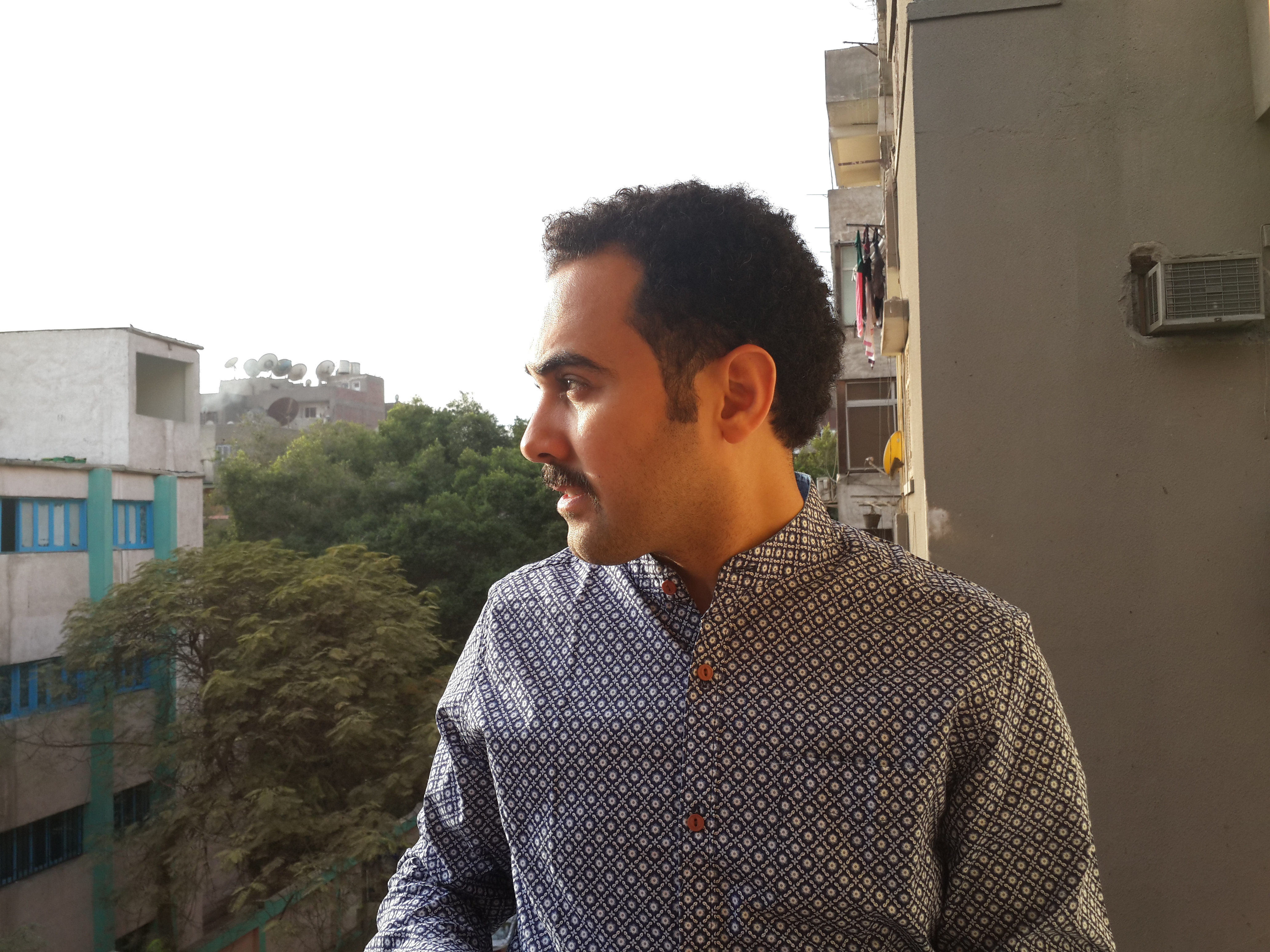
20151126_155258

Naje’s first novel Rogers was published in 2007 and later translated into the Italian in 2009. The novelist is recognized for his writings on contemporary art and indie music. With Clare Davies, he co-founded the art magazine Mhwln, dedicated to researching the history of contemporary art in Egypt. Naje’s second novel Using Life has been curated into exhibitions, an animated film, and a multimedia performance.

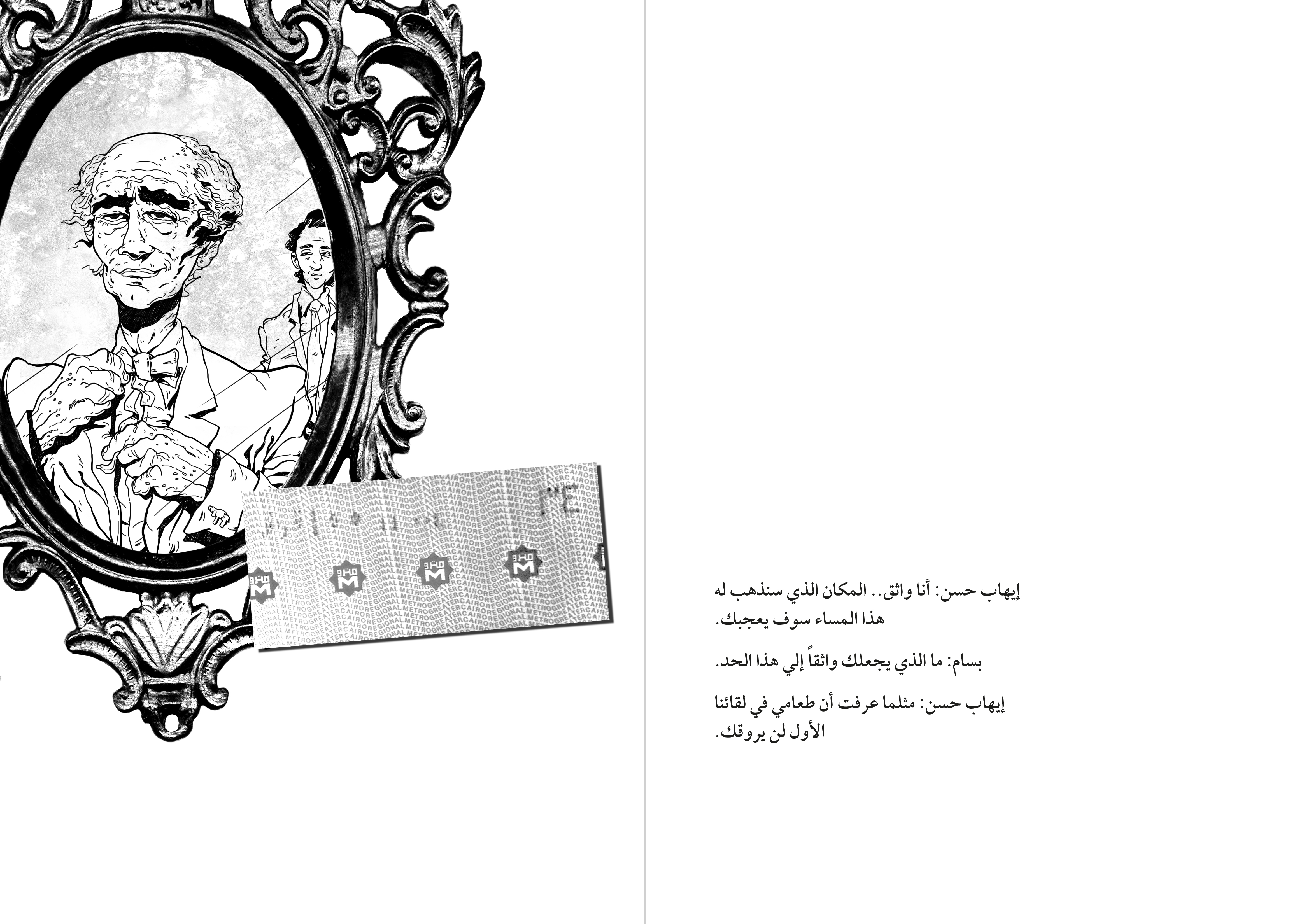
Using Life anticipates a dystopian end for Cairo at the hands of a secretive group of architects, and comic artist Ayman Zorkany provides the striking horizontal images of a city nearing its death. I asked Naje about his expository experiment on the themes of sex and drugs in a context of censorship and persecution. This interview began during Naje’s recent visit to New York and was later completed via email.

¤

MONA KAREEM: You are facing charges for “indecency and disturbing public morals.” What exactly bothered the public prosecutor about chapter five of your novel?

AHMED NAJE: According to their investigations and official documents, my fiction registers as a confession to having had sex with Mrs. Milaqa (one of the characters in my novel), from kissing her knees all the way to taking off the condom. They also object to my use of words such as “pussy, cock, licking, sucking” and the scenes of hashish smoking.

Ironically, this chapter speaks of the happy days of Cairo, as opposed to the days of loss and siege dominant in the remaining chapters. This specific chapter is an attempt to describe what a happy day would look like for a young man in Cairo, but perhaps a happy life feels too provoking for the public prosecutor!

I think they have other objections too, like the fact that your text is now in the public domain, exposing a life of immorality via literature. How do we deal with such a moral code?

There is no single method to deal with persecution and censorship. For example, my novel was published in Beirut before being released in Egypt. While there is no regulated censorship on books printed in Egypt, any book coming from outside must be approved by the censorship office. Meaning the book had to pass official approval before distribution. However, this did not prevent a “concerned citizen” from submitting a complaint against me, nor did it stop the prosecution from pressing charges.

There are articles in the Egyptian constitution that protect the freedom to write and create in all forms, but the public prosecution has persistently stood against these rights. They work as guards for social morals and virtues, rather than for laws that protect freedoms. This is getting worse since Abdel Fattah el-Sisi became president. He came to power through an alliance with state institutions such as the judiciary, and together they share the responsibility of guarding their gains. El-Sisi looks after his interests while the judiciary dedicates itself to policing morality and teaching us virtues.

Lately, the Syndicate of Musicians and the Syndicate of Filmmakers were given the legal power to police artists and performances. They can, for example, raid a party or a concert to ask for legal permits. They can even arrest artists for “immoral acts” or performances. The moral code in Egypt is closely tied to the structure of power.

How did Egyptian writers react to your trial? I know the novelist Sonallah Ibrahim will testify in court for you.

Writers from Egypt and other Arab countries expressed their support and solidarity, and it is because many of us feel threatened. When I called Sonallah, we joked about the accusations because they could be used against almost any book. Sonallah was once jailed for his political views. He advised me to take the case seriously and work closely with lawyers because we have no option but to go along with this Kafkaesque trial. Sonallah, Mohamed Salmawy (head of the Arab Writers Union), and Gaber Asfour (former Minister of Culture) will be testifying in court to clarify that my novel is a work of imagination and creativity. Their testimonies will address the difference between a novel and an article, the ways to approach a work of art, and the place of sexual descriptions in Arabic literature.

This is not the first time a reader acts as a volunteer policeman over Egyptian literature.

I really enjoyed the dramatic statement of that plaintiff reader. He told the prosecution that he buys the journal regularly for his daughters, but that one time, his wife walked into the room showing him my published chapter and ridiculing him for bringing such writing into their home. He said his “heartbeat fluctuated and blood pressure dropped” while reading the chapter.

I do not have a problem with the reader or his behavior and complaint. I actually apologize for the inconvenience I caused for their marriage. The problem lies with the public prosecutor who is given the power to interrogate and launch accusations. Despite the political conditions in Egypt, the prosecution worked for months investigating the difference between a novel and an article only to push this case against me. They were researching the nature of Ahmed Naje’s relationship with his fictional character Mrs. Milaqa. The lawyers and I initially thought the case would be dismissed, but the public prosecutor himself signed the decision to press charges accusing me of “misusing writing to create foul stories that serve artistic lust and mortal joy.”

Speaking of lust, tell me about the importance of sex and drugs in your fiction?

There is not much sex in this novel, but there’s desire: rough and flaming, or still and quiet. Desire is the ghost of this novel. As for drugs, you will see no addicts in the novel, but rather social gatherings in which alcohol and hashish are present. I think what gets them to label my work as “indecent” is the use of words, like naming sex organs. Such naming is not common in contemporary Arabic literature, although dominant in the Arabic canon, oral histories, and the everyday language. Lately, some writers, myself included, decided to reclaim this diction. As in the novel, lust — not sex — is always present in Cairo. We are talking about a city where police and society do not allow for a kiss by the Nile River, while turning their backs at the daily incidents of harassment. Sex disappears in Cairo, but the process of sex is continuously present in the public idiom when representing life in the city and the class structure. This repressed desire creates a deep sense of dullness that reflects on experiencing the city and its current tragic moment.

And how do these themes play into the novel’s dystopian vision of Cairo?

It revolves around love and friendship at its core because drugs and sex are closely tied to friendship. Drug consumption is often a collective act that helps build connections. Using Life is a novel about love and friendship in Cairo. I think Cairo is a city that deforms relationships. The breathless rhythm of the city pushes desire to its peak, while installing a feeling of permanent fear in the individual. Therefore, there is not a complete sexual adventure. For example, the protagonist Bassam tries to approach an aristocratic transsexual woman. He is eager to have this adventure with her, but when the foreplay starts, he escapes.

In the final chapter, we arrive at a new Cairo after it is hit by a tsunami. The new city is supposed to be like Dubai or some futurist utopia, but for Bassam it is a dystopia. In this futurist part, the fictional intersects with comics depicting a man who goes to the factory to work with a printing machine. The worker then dies under the overwhelming pressure of hard labor and mad lust for the machine. The chapter closes with the machine printing off his sentence “I want to fuck you to death.”

I know you like to work with other mediums, like the comics in Using Life and music in Rogers. How does this interdisciplinary approach serve your work?

It has to do with some literary hallucinations and illusions that frame my vision of the novel as an art nearing extinction. I think of the novel as something close to epic poetry. So this can be read as an epic about a world of machines and printing and modernity. Images continue to take over the human consciousness, leaving us with a new language. Readers are approaching novels expecting to watch a movie that has a clear beginning and ending. They speak religiously of plot, story, and dramatic elements. In my more hallucinatory work, I try to push these borders by examining the relations between the novel and other arts, and between the writing process and other artistic modes of production. I build my work on this ground.

In my first novel I used Pink Floyd’s The Wall to build the story. There were two worlds: one of the album and another of the novel. I think it helped readers interact with the text. The Italian musician Massimo Croce produced a whole album based on Rogers. To me, this back-and-forth with the reader and with collaborators is most enjoyable. I wrote Using Life while thinking of the illustrations. So I scripted the comics then passed them to Ayman Zorkany to produce them. Ayman too loves this type of creative process, inviting readers to color his comics however they like. One chapter entitled “Animals of Cairo” served as a visual dictionary of Cairo’s deformed and metamorphosed animals. Some readers sent us illustrations of other animals they imagined. I enjoy these small exchanges and consider them part of the writing process.

When is the English translation coming out?

Texas University Press is planning on releasing it sometime next year.

¤

Mona Kareem is a poet and journalist based in New York. She has published two collections of Arabic poetry, and is currently completing a PhD in comparative literature while teaching writing courses.

—- ——-

Main link: https://lareviewofbooks.org/interview/the-persecuted-novelist-of-dystopian-cairo

Share

Farewell to the youth

Translated by:

Dina Hussen

Editor’s note: The author of this piece was acquitted on Saturday of charges related to the publishing of a chapter of his novel, Istikhdam al-Haya (Using Life), in Akhbar Al-Adab newspaper. Authors and writers have expressed solidarity with Naji, considering the ordeal a flagrant violation of freedom of expression and creativity.

I first saw the beast in 2005, in downtown Cairo, in front of the Journalists Syndicate steps. Young men and women gathered and chanted “kifaya” (enough). The beast, dressed in military uniform, stormed out of police vehicles. It was also disguised in civilian attire, beating up protesters and dragging them along the ground. In the streets of downtown Cairo, security forces undressed and sexually assaulted female protesters. It was a great shock. We thought this was the worst the beast could do to us. We thought this offense was enough to destroy the beast. These presumptions reflect the naivety and arrogance of our youth, and are telling of its pure heart and true emotions. Repelled by the consequent feverishly confrontational rhetoric, I withdrew from all battles with the beast.

I had encountered the same naivety five years earlier. I was a high school student in 2000 when I joined a students’ protest in solidarity with the Second Intifada. The former Israeli prime minister and war criminal, Ariel Sharon, had visited Al-Aqsa Mosque and sparked the Palestinian uprising. Israeli forces then assassinated a 12-year-old, Mohamed al-Durrah, while he was in his father’s arms. Our schoolteachers encouraged us to protest, but did not demonstrate themselves. They encouraged us to walk in small angry groups, chanting for the liberty of Palestine, vowing never to forget retribution for Durrah. The security forces then allowed us to demonstrate in bigger groups outside the schools gates, roaming the streets of Mansoura, where I spent my teenage years. The children and students surrounding me were in ecstasy because they had obtained the right to scream and found freedom in the streets for the first time. And when groups of marching students encountered each other they embraced theatrically. Schools in Mansoura, as across the country, are segregated by gender. It was amazing to watch boys and girls mingling in these protests, as opposed to the usual scene of male students waiting outside of girls’ schools to harass them, pick them up, or engage them in emotional adventures. But the crowds, screaming, over-excitement and the egoism of those miserable souls dying to lead the chants, left me mentally disassociated, despite being a part of it all.

I would learn five years later, upon my graduation from university, how Hosni Mubarak’s regime not only allowed the anti-Israel protests but supported and even instigated them. Mubarak wanted the cameras to film the angry crowds as they burned the Israeli flag in order to point at the image, address the gods in Oslo’s mountains and Washington’s valleys and say, “I am here to control these beasts, so that they don’t burn down everything.” When the anti-Mubarak protests later took to the streets, security forces encircled them. Because they had not become beasts yet, Mubarak’s regime made sure they did by undressing female protesters and sexually assaulting young protesters. Instead of becoming beasts, however, they chose defeat and sought revenge through victimhood.

I became jaded by the ridiculousness of the charades we are summoned to participate in, such as elections. This was in addition to the calls for limiting religious and sexual freedoms in the name of religion, and other travesties that conjure up the idea of the nation. They instruct you on the importance of loving the nation and tell you how to do so. These directions did not suit me or various other people I met online. We thus preferred to create our own virtual reality, outside authorities’ control. We created a space that contrasted with the tedious moral principles of our fathers. Egypt was passing through great times. Everyone on television was talking about a democratic transformation. In the authority’s blind spot, we made small venues to hold parties and play music prohibited from broadcast radio and television (both public and private), because it doesn’t contain the usual tacky love song lyrics. In one of these parties, Alaa Abd El Fattah suggested we create a parody of the president’s website, and that I compose its comic content. These were the kinds of games we played. We used delve to into our virtual bubbles and make fun of the naked king, and how his entourage and slaves praised his garments.

I met my first wife on an online forum for the fans of [popular Egyptian singer] Mohamed Mounir. We were teenagers, barely 18 years old. Together we spent an often turbulent 10 years of love, marriage and divorce, a complete cycle of life. Others met on the forums and blogs of the Muslim Brotherhood, the Revolutionary Socialists, the “foot fetish club,” the “Bin Laden warriors” or the “‘Fatakat housewives’” forum. In contrast to the [political stagnation] that manifested in catting about Mubarak’s unfading pitch-black hair dye, the internet was a new home for those holding similar views to get together. The faint humming of these groups’ discussions gradually became audible. With the help of hearing aids, the old guards began to describe that humming as the voice of youth. They labeled young people as aliens to society, and then agents of the West and immorality. In any case, they did not take young people seriously or understand them.

“The old corpses should make way for the new corpses.”

The old zombies were taking up all the seats. The zombie general, the zombie sheikh, the zombie president, the zombie businessman, the zombie ruling party, the zombie opposition, the moderate Islamist zombie, and the radical Islamist zombie. And all they offered the youth was to be zombies and let go of their idealistic dreams and ethics. We were forced to mingle with these zombies. We were forced to converse with them, coax them, sometimes praise them, in order to protect ourselves against their evil. “With cold hands, we got into their midst; we looked but could not see,” is how poet Youssef Rakha described the situation years later in his great poem, On Sleeping with Reality. When we opposed them or refused to consume their archaic understanding of the nation and religion, we were faced with torture, marginalization and siege.

“Live like your parents have lived,” said the zombies. In his movie The Mummy (1969), late Egyptian filmmaker Shady Abdel Salam tells us that our parents lived as scavengers. Girls walk in the streets with their shoulders curved forward and heads looking down with a desire not to be noticed. They don’t look left or right, often getting catcalled and harassed in silence. When they decided to stand up against mass sexual assault in the heart of the city, zombies accused girls and women of attracting criminal harassers and arousing them.

Demonstrators first took to the streets to protest police brutality and torture. They were accused of insulting the police. Protests kept growing in size and magnitude, eventually calling for the removal of the zombies’ leader (who taught his disciples his hair-dying technique). The zombies then congregated to address the youth. “Consider him your father,” they said, in reference to their leader.

Common traits of young people include passion and emotional vulnerability. As much as passion fueled the revolution, gushing blood in the veins of the agitated masses, it also prompted mercy and pity. It was precisely this passion that transformed the revolution into a quest to seek retribution for the martyrs, and prevent the children from killing their zombie fathers.

In many of Pauline Beugnies’ images in her photo book Génération Tahrir, we can see heated discussions between girls and mothers, between the young and the old. What’s not audible, however, is the sound of the screams, debates and opposing views. But the photos do make clear to us the magnitude of the authority the zombie fathers possess and the immense pressure young people are under.

I knew many young men and women who took to the streets, burning car tires and occupying the frontlines in the battle against the criminal elements of the police force. But the moment their phones rang, they would quickly escape to a quiet spot to answer their mothers’ calls. “I’m fine and far away from the clashes,” they would say. They must have thought rebellion could exist in a parallel reality away from familial life. I have also known activists who work on LGBT rights and are brave enough to advocate this issue in a [conservative] society like Egypt’s. They defend these rights in a court of law, in front of the police, and so on, yet cannot muster the courage to announce this to their parents. My female friends who gave officers the finger as they were being shot with the police’s rubber bullets used to weep in the face of parental and societal pressures. They are pressured to assume a single path in life, a future that includes nothing but marriage and bearing children in a cycle of reproducing more zombies.

This cowardliness and hesitancy led young people to always try to find a middle ground, only to eventually be deprived of everything by their fathers. They cheered for moderate Islamists, as the Brotherhood youth claimed that Islam is an identity and a moderate religion compatible with democracy. The Brotherhood youth claimed there was no place for secularism in our national identity. Then the Islamist zombies announced that there was no difference between Islamic State militants and us. They called those militants “mujahidin” and pledged to send their young people to fight on their side in Syria. When young democrats cheered for the civilian coalition led by a military general, they justified this. “Look at Sisi’s eyes,” they said. “They radiate warmth and love; he will save this nation and build a secular state.” The general responded by prohibiting speech and jailing everyone. Others were killed in public squares and football stadiums.

The Gulf sheikhs, the agents of the Western gods in the region, backed up the general. Along with the zombies and the general, they opted to deprive young people of all spaces, even virtual reality. Internet surveillance systems were put in place and a single tweet could put its writer behind bars. They invested millions in the internet, turning it into a mega shopping mall, controlling its content through social media companies that decide what’s trending. If a single story surfaces on a new torture case inside an Egyptian prison, it is quickly buried under piles of entries and clicks on the new shapes of Kim Kardashian’s butt.

A few weeks ago, I began sensing a faint, dull pain in my left testicle. The doctor told me I’m suffering from a case of varicocele in my testicles. He advised me not to stay standing for long periods of time, cut back on sexual intercourse and refrain from prolonged erections. When I asked him about the cause, he simply said, without taking his eyes off his newpapers: “Most probably it is genetics and age.”

No more prolonged erections for our generation; we are dispersed all over the world. Some are in jail, some are exiled and some are willing to be drawn to the Mediterranean’s European shores. Others aim for an exit from hell to God’s promised heaven through a path of beheadings. Those who have stayed have secured a place among the zombies. They appear on television as youth representatives, take selfies with the zombie general and sheikhs, and compete over the crumbs Gulf amirs and sheikhs often throw at them.

Now it is time for documentation, archiving and preservation before we depart with the past and our youth. Let’s bid farewell to our sorrows and ghosts. Let’s search within for a new path and revolution. The greatest danger lies in giving into nostalgia, to the old ideas and principles, and to assume there is a golden moment in the past that should be retrieved. The greatest danger is in revering the picture. Any form of reverence — for the revolution or the martyrs or higher ideologies — is enough to turn you into a zombie without even noticing it.

This essay was first published in French as an introduction to the book Génération Tahrir, for which photographer Pauline Beugnies followed the stories of various artists and politicians during the 25 January revolution in 2011.

Share

What’s the Real Nature of Ahmed Naji’s Novel ‘The Use of Life’? By Elisabetta Rossi

Ahmed Naji’s court date has been set for November 14, at which time he and his attorneys will have to defend his novel-excerpt published in Akhbar al-Adab, which has been accused of defaming Egypt’s “public morals.” What kind of book is Naji’s The Use of Life, which now finds itself at the center of such a court battle?

Elisabetta Rossi, who translated the novel Arabic into Italian, answers:

By Elisabetta Rossi

01_02text

If we were to attempt to classify Ahmed Naji’s work within a well-defined genre, we would face no small issue: The young author, born in Mansura in September 1985, has distinguished himself on the Egyptian literary scene for his unique experimental writing, where genres and artistic elements converge to shape a hybrid literary product.

Naji started blogging in 2005 at Wassia’ khayalak(Widen your imagination), a free space where he writes about cinema, art, literature, sociology, and human rights. It was 2006 when he got his Master’s degree in journalism, after which he found work at the weekly literary magazine Akbar al-Adab. He followed with his debut novel in 2007.

But Naji has many other interests as well: In 2009, he published an e-book titled Saba῾a durus mustaqqah min Ahmad Makky (Seven lessons drawn from Ahmad Makky), a short work of art criticism. He also wrote about the history of Egyptian blogging in “Blogs from Post to Tweet” (2010), an overview of the main Arab blogs from 2003 to 2010.

Since his early days as a writer, Naji has presented himself as a new voice in Egyptian contemporary literature. His first novel, Rogers, published in 2007 by Dar Malamih, could be defined as fantasy. Yet it’s something more: In this novel, with neither plot nor temporal laws, the words of the author are mixed with those of the songs from Pink Floyd’s The Wall, which cleverly interleave the narrative. The “Wall” stands as the symbol of alienation, and the whole story is a game played by the protagonist’s imagination and hallucinations. It was an original literary experiment that had an important echo also in Italy, through Barbara Benini’s translation.

The nightmare, the anguish of alienation, and the individual’s inability to communicate are also some of the main themes that can be found in The Use of Life (2014), a new experimental novel that, likeRogers (2007), uses another artistic “ingredient” to develop the story: the illustrations and comics of Ayman al-Zurqany. These give a face to the characters and describe their feelings and thoughts. The use of comics and drawings — here perfectly combined with the prose — represents an absolute newness on the Arabic scene. It also testifies to the growing importance of the art of comics, which can be found in magazines like TokTok, al-Shakmagiyya, and the science-fiction Fut 3aleyna bokra, written and illustrated by Sherif Adel.

In Naji’s case, the book isn’t exactly a “graphic novel.” Instead, it’s a middle ground between novel andriwayya musawwara.

The story in The Use of Life revolves around two main characters: Bassam and the city of Cairo. Bassam is a young man who lives, frustrated, in a city where he can’t smile or express himself. Everything is difficult in the dirty, polluted, degraded city. Even relationships: “Every romantic relationship in Cairo is tense. Naturally, every romantic relationship is, in general, tense. But the amount of pressure exerted by the city and its inhabitants complicates the tension of these relationships. At any moment, a male might lose his masculine image in front of a bawwàb or an old biddy neighbor,” Bassam says in the novel.

And what about the city of Cairo? Many times, postmodern literature has described metropolises as hellish places to live. But here, Nagy creates a semi-fantastic expedient — the secret “Society of Urbanists,” which aims to radically transform the capital.

Within this surrealistic texture, we follow the adventures of many unconventional characters, including transgressive Mona Mi; the transgender Sally; Rim, the girl split between freedom and tradition; Mud, Bassam’s tormented friend; as well as the two Society of Urbanists antagonists, Ihab Hassan and the magician Paprika. The last two represent an encounter in the novel between fiction and reality. Ihab Hassan is in the reality an Egyptian-American postmodernist theorist who’s well-known and appreciated by Naje. In the novel, however, he is an eccentric professor who holds many secrets about the history of architecture. Meanwhile, Paprika is a magical character with powerful and unknown magical powers.

The leitmotif that links the characters is often sexuality, a topic that Naji treats without holding back. The novel appears particularly irreverent when the author talks about masturbation, fetishes, and pornography:

“What do young people in their twenties do in Cairo? Do they lick pupils, pussies, do they suck dicks, do they lick dust or do they inhale hashish mixed with sleeping draught? Till when will fetishes be exciting, innovative, and stimulating?”

This is what Bassam asks in the censored chapter six. This particular segment of the story deals with the use of drugs among young people in Cairo, and it starts with the scene of a party full of music, cigarettes, and hashish, and it culminates with a detailed scene of Bassam having sex with an older woman. Naje’s work is salted with other sexual situations, which provide contrast with the harsh traditionalism described through Bassam’s ironic lens.

The novel also has science fictional elements. As Professor Ada Barbaro shows in Science fiction in Arabic Literature (La fantascienza nella letteratura araba, 2013), the imagination of a different future is one of speculative fiction’s core obsessions. Indeed, this is the target of the secret Society: create a new model of the world system, which will erase the problems of the present. Another science fictional element, which leans toward the apocalyptic, is found at the book’s beginning. It opens with a description of a naksa, a terrible destruction of millenary Cairo caused by a series of unexplained natural disasters which will overwhelm the city and its historical and cultural heritage.

Dreams, illusions, imagination, subtle social criticism, and irony: All these elements constitute the sophisticated reflections of a sensitive author who aims to create his own style, where the Fantastic, Pulp, Noir and New Weird literature blend together in a new form of literary language.

Elisabetta Rossi studied Arabic language and culture in the Faculty of “Oriental studies” in the University of Rome “La Sapienza”. She lived in Cairo in 2013 and in 2014, she had a scholarship given by the University of Rome “La Sapienza” to study Arabic language at the “Ayn Shams University” in Cairo, where she made a research about Egyptian comics and graphic novels. In 2015 she got a Master Degree with the translation and the analysis on Nagy’s work, titled “Use of Life: the meeting in Cairo between fantasy and graphic novel.”

Share

The Bourgeoisie, Real Estate, and Nation-building, or How the Egyptian and Middle Eastern Art Markets Operate

In 1989, Egyptian billionaire businessman Nassef Sawiris walked in to a trade fair at the Marriott Hotel in Cairo. Various luxury goods were exhibited alongside high-end furniture and expensive antiques. An exhibition of works by important artists of the period occupied one corner. The portraitist and still-life painter Sabry Ragheb was the most prominent member of that group. The exhibition organizers, Shahira Idris and Ghada Shahbandar, were venturing their first steps into the world of collecting, buying, and selling art; Ragheb had loaned them one of his favorite paintings as a gesture of appreciation.

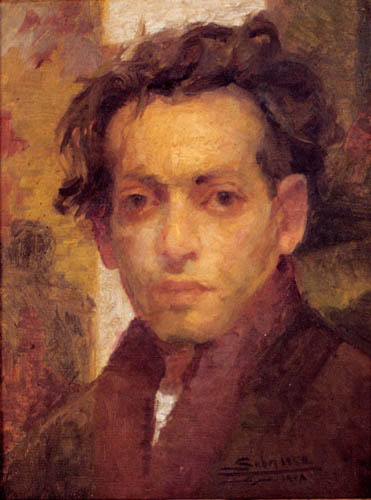
Sabry Ragheb self portrait

Sawiris fell in love with the work, a still-life of a red rose and, as with love at first sight, the world was no longer the same. He asked to buy the painting. Shahbandar and Idris responded that the work was not for sale, but Sawiris insisted. At his urging, Shahabandar contacted Ragheb, who was angered by the request and refused. Still, Sawiris persisted. In response, the artist demanded a then unheard of sum for the work, equivalent to three times the standard market price: 10,000 Egyptian pounds (LE). Sawris’s response was quick and decisive: “Agreed.”

The sale set a new benchmark. According to Shahbandar, Ragheb’s painting represented the most expensive painting sold at the time by a contemporary Egyptian artist. In this period the market was in flux and prices, which, previously had settled in the hundreds of Egyptian pounds, reached into the thousands. Urban sprawl led to the establishment of new satellite cities outside of Cairo. Saddam Hussein’s invasion of Kuwait in 1990 edged the last remnants of an ideal of Arab unity towards collapse. Maps were changing, and the Arab art market was taking its first shaky steps.

The world before 1989

In the 1950s and 60s, the state nationalized artistic life in Egypt; the cultural administration was restructured and most significant artistic initiatives and cultural spaces operated under state supervision. In the 1980s, only a handful of private galleries were operating in Cairo. Prior to the sale of Ragheb’s work in 1989, says Shahbandar, the maximum amount paid for a painting was no more than 3,000 LE. According to her, the Safar Khan Gallery and Tareq al-Marsafi’s Arabesque Gallery represented the most prominent art spaces at the time. The audience for art was limited primarily to a short list of names of collectors who confined their purchases to the works of already prominent, well-established artists. Nevertheless, economic liberalization policies were already having an effect and art’s relationship to the market was beginning to change, witnessing a gradual increase in prices and the emergence of a broader public interest in the arts.

In this period, the state largely withdrew from the cultural sphere. In partnership with her friend, Shahira Idris, Shahbandar invested her energies in interior design, and in dealing antiques and paintings. The two also began visiting art shows and meeting with artists. At the time, many contemporary artists in Cairo had work spaces in Wikalat al-Ghoury, a caravanserai constructed in the early 16th century, or in one of the several other historic buildings the state had restored and lent to artists as studios. Visiting such places helped Shahbandar develop a wide network with artists of all generations.

Despite its many flaws, the state system worked well in many ways, and was comprehensive, providing artists with an overarching framework of support. In addition to offering studio spaces, the state sponsored galleries and ran an acquisitions committee, as well as juries that awarded prizes to artists. In the 1980s, however, Egypt was transitioning to a free market system, efforts were made to “re-organize” the public sector, and state spending was cut from all sides. As international corporations entered the Egyptian market, private exhibitions were held at Cairo’s five-star hotels for the country’s new economic elite. It was at these shows that Shahbandar and Idris displayed works by contemporary artists for the first time. Their exhibitions attracted the attention of a segment of the public, and the two branched out, organizing shows lasting just over a week in private residences, often in the empty apartment of an acquaintance. Their clientele grew as a result, as did the circle of artists they worked with.

Shahbandar and Idris exhibited works by artists who had come to prominence after 1952 including Salah Taher, Hussein Bicar, Gazbia Sirry, Maurice Farid, and Nagy Basilios, as well as younger artists active in the period, some of whom went on to pursue high profile careers such as Samir Fouad, while others, such as Huda Khaled and Fatima Rifaat, remained relatively obscure. Other artists, such as Hassan Soliman, refused to work with the duo because he objected to exhibiting in makeshift gallery spaces. He did, however, recommend artist-colleagues with whom he thought Shahbandar and Idris might be interested in collaborating.

Shahbandar was active in the art world from 1986 through the mid-1990s, making a name for herself as one of the scene’s most prominent figures. Nevertheless, the material returns were modest, and she was unable to lease a place permanently and transform it into a fully equipped gallery. She continued to work on her own and began receiving various requests for consultancy services. The influx of international corporations to Egypt introduced new work habits and marketing strategies. These companies recognized art’s ability to serve as a foil for the identity of the company or corporation and as a long-term investment. The international corporations that had recently begun operating in Egypt, approached Shahbandar for assistance in selecting art for their offices. She chose works and arranged them in the local headquarters of several large companies including those of American Express and Carpet City. On occasion, she was asked to work on a smaller scale: for example, acquiring paintings for the office of a company executive or installing works on a single floor.

In 1990, Stefania Angarano arrived on an exploratory visit to found Mashrabia Gallery in downtown Cairo. Previously, she had worked at a number of Italian galleries specializing in contemporary art. Angarano recalls how, when she arrived in Cairo, some galleries were displaying and selling paintings paired with couches and other pieces of furniture. Her primary aim in coming to Cairo was to establish a space that presented art as an integrated whole, rather than as an element of interior design chosen to match the drapes.

Art enters the free market

The factors contributing to the transformation of the art market in the late 1980s were not limited to the entrance of international corporations. In this period, the government expanded construction projects and support for the capital’s new satellite cities, resulting in significant growth in the real-estate market, especially to the west and east of Cairo, with the construction of 6th of October City and areas around Nasr City and the Fifth Settlement. Within the city’s existing bounds, villas were being torn down to make way for apartment buildings, while on the margins, opulent mansions sprang up. An economic elite that had emerged on the back of the open-market, or infitah policies introduced by President Anwar al-Sadat in the 1970s took to buying art as a means of generating (and flaunting) class distinctions; hanging original paintings and works of art in the home became a marker of social exclusivity. This was a period of great extravagance.

At the same time, many works by leading artists of the early 20th century, which had previously remained out of sight became available during this period, including sculptures by Mahmoud Moukhtar and paintings by Mahmoud Said: perhaps the most celebrated of the “Pioneer-generation” artists credited with founding a modern Egyptian art movement. In an emerging market lacking sufficient legislation and institutional oversight, counterfeits proliferated. Soon, Shahbandar found that, in addition to her role as art dealer, she was also compelled to act as an investigator: examining the authenticity of each painting. She tells the story of one incident in which she was asked to appraise a painting by Hussein Bicar. When she brought the painting to the artist for verification, he smiled slowly and told her that it was a good painting, but it wasn’t his; someone had imitated his style.

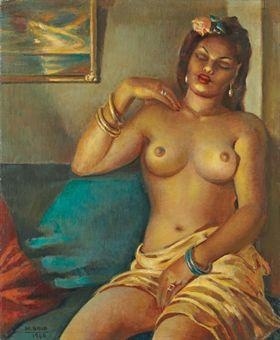
The Nude with the Golden Bracelets and The Reciter

This hothouse climate in the art market tended to foster the sale of certain kinds of works over others. The depiction of nudity represented one of the primary factors informing the kinds of works circulating in the market after 1989. Sultan al-Qassemi, Chairman of Barjeel Securities and founder of the Barjeel Art Foundation recalls that images of nude paintings by Mahmoud Said published in an auction house catalog of the period were censored. At the same time, Karim Francis, director of the Karim Francis Gallery in downtown Cairo, defends this approach, which he frames as a response to laws in Arab countries regulating the display of nudity rather than any rules imposed by the auction houses themselves. Shahbandar, for her part, believes that the moral basis for an assessment of the value of a work of art or the tepid reception of paintings of nudes can be attributed to the predominance of specific social values.

WOMAN WITH GOLD BRACELETS, OIL ON CANVAS, SIGNED AND DATED BY MAHMOUD SAID
79 x 65 cm. (31 1/8 x 25 5/8 in.)

In the early 1990s, Shahbandar exhibited a painting by Said, which was priced at less than 100,000 LE. The Institut du Monde Arabe in Paris had turned down the work-titled Nude with Gold Bracelets (1946)-preferring, instead, she reports, to purchase and display Said’s The Reciter [date unconfirmed]. Representatives of the Institut claimed that the painting of the pious reciter of the Qu’ran was more representative of Egyptian art than a painting of a nude, dark-skinned woman. According to Shahbandar, “In the 1980s and at the beginning of the 1990s, a general social climate prevailed that rejected paintings of nudes. This was not just due to the spread of Islamism; it involved all sectors of society.” Sitting in her home, Shahbandar gestures towards a painting by Sabry Ragheb depicting a girl applying makeup in front of a mirror and wearing a short, black nightdress. The painting had been purchased by a woman from a middle class, Coptic family. A few days later, the client returned, asking to exchange the work because her daughter would not tolerate having a painting of a nude in the home. What Shahbandar describes as mutable social mores came to inform the practices of cultural institutions, such as the Institut du Monde Arabe, that played a prominent role on the international stage and sought to influence perceptions of Arab identity abroad. The same values came into play in even the most basic forms of social organization, such as the family. Shahbandar tells of how she would use her own exhibition space to display nude paintings by Georges Sabbagh from private family collections because the children of the owners refused to display the works and approached her for help in selling them.

Others, such as Mohamed Talaat, the director of Misr Gallery in Cairo’s upscale neighborhood of Zamalek, believe that those social values that discouraged the exhibition of nudity have since changed. In 2012, for example, Misr Gallery exhibited various works created by Nadine Hammam over the course of the period following the January 25th revolution of 2011. The exhibition, titled Tank Girl, was composed of acrylic paintings representing the eponymous female nude who confronts the viewer from atop a tank with her legs spread, transforming the barrel of the gun into a larger than life size phallus. An explanatory booklet accompanying the exhibition framed the work in the following terms:

“Through her work, which she has titled Tank Girl, the artist sets out to reconfigure stereotypes and established beliefs. In this reformulation, Hammam simulates a combination of power inversions in which a woman controls one of the most vicious war machines, the tank, as a symbol suggesting ‘woman’s’ ability to impose her power and prevail in the battle to assert their existence.”

The booklet closes with a paragraph that explains: “Through her treatment of these complex symbols, the artist hopes to locate a more active role for modern women in the political and social scene. Here, Tank Girl represents every Egyptian woman.” According to Talaat, those collectors with an interest in buying art today are attracted to the more contemporary works in various media and don’t have a problem works that contain nudity or even erotic content, such as works in the Eros collection by el-Dessouki Fahmi, a portion of which was also shown at Misr Gallery.

New adventurers

Until the mid-1990s, there were no clear laws on the art market for setting prices and confirming the authenticity of works of art. An ethical code existed, but no supervisory body. Artists set their prices and the galleries exhibited their works, earning a percentage on sale. Some of the artists active in the 1980s harbored misgivings about this system and asked galleries to purchase their works instead of handing them over directly for consignment. At the same time, artists were not immune to questionable behavior, and cutting out the middleman by selling work at a lower price than that that advertised in the gallery constituted one of the worst possible violations of the ethical code Yet, apart from the latter, Egypt has no laws in place regulating the art market.

A case brought against the Aida Ayoub Gallery in 2005 (Case 2238/3) laid bare some of the flaws in Egypt’s art market. Aida Ayoub began working in the art world in the early 1990s, and sold her clients dozens of paintings forged by the late artist Yousri Hassan. After opening her gallery, Ayoub quickly established a broad network in Egypt’s art world and was awarded the honorary title “Patron of the Arts” by the Minister of Culture. The forgeries were only discovered when May Zaid, one of Ayoub’s clients, tried to insure some of the paintings she had purchased, only to discover the deceit. Due to the absence of Egyptian laws penalizing art forgery, the courts dealt with the case as an act of fraud.

The uptick in activity in the Egyptian art market stemmed from the drive among the new upper middle class to acquire artwork. Some of these individuals were encouraged to enter the market based on a business approach that relied on a logic of quick gains. Until the mid-90s, most owners of private galleries in Egypt were women whose interest in art had prompted their entry into the field; the need to make a profit proved a secondary consideration. Sherwet Shafie represented another prominent art world figure. Shafie had opened the Safar Khan Gallery after leaving her position as a program presenter on Egyptian television in the 1960s. While Safar Khan Gallery still operates today, Shahbandar stopped working in the field in the mid-1990s due, she claims, to the type of clients who were beginning to take an interest in art. She recalls standing with the artist on the occasion of the opening of an exhibition she had organized, when they overheard a client saying she wanted to buy a painting because the colors matched her living room interior. The artist was insulted and pleaded with her not to sell the painting to that client. In 2005, Shahbandar would found Shayfeencom (We are watching you), a movement that aimed to uncover the corruption and electoral fraud of the Mubarak regime. She would later become one of the most prominent names in political activism, especially after the 2011 revolution.

Shahbandar withdrew from the field just as the new adventurers were entering. At the time, Karim Francis was embarking on a journey of self-discovery which took him from working in the import/export business to tourism, and, finally, to art. Francis devoted three years to reading about art, and familiarizing himself with artists and various artistic practices before opening his own gallery. He held his first show in 1995 in an apartment he owns on al-Sherifein Street in downtown Cairo. The group exhibition, titled Identity included works by artists such as Mohamed Abla, as well as literary works, displaying manuscripts belonging to the celebrated novelist Sonallah Ibrahim.

Sitting in his gallery, surrounded sculptures by Sobhy Guriguis, Francis recalls his beginnings:

When I started working in the art world, most buyers were receptive to works by the older, well-established names. Quite simply, each buyer felt in touch with the artists of their generation. However, motivated by my own passion, I wanted to put new names and new ideas in art out there that had not yet been seen in the market. I held a series of group shows titled New Talents to introduce artists whose work was being shown for the first time, as well as to show artistic modes and experimentation that went beyond paintings hanging on a wall, including installation artworks and video art.

This spirit of innovation and embrace of the unfamiliar would come to define the direction of the art scene in the late-90s and early 2000s. Francis, alongside other gallerists active in the period and espousing similar ambitions, helped provide a platform for the emergence of a number of artists who are often referred to collectively as “the 90s generation.”

The joy of the sale

In the 1990s, state financial policies continued to liberalize so as to integrate Egypt into the new world market, and Egypt signed many partnership agreements with the European Union. These agreements included articles explicitly referencing cultural cooperation; a number of foreign cultural institutions became active in Egypt. Initially, these institutions were viewed with a great deal of suspicion, and were boycotted by art critics: most prominently Osama Afifi, who understood the activities of foreign cultural and arts organizations to represent a form of interference with Egypt’s natural course and part of a larger plan to destabilize Egyptian national identity. From the Ford Foundation to the Townhouse gallery (to borrow Afifi’s examples), the arts organizations that played an important role in supporting contemporary artistic practices were subjected to attacks of treason and suspicion, to the extent that art critic Sobhi el-Sharoni described the role of these organizations as malicious in his book Encyclopedia of Egyptian Fine Arts in the Twentieth Century.

This model of arts organization does not rely on selling art but, rather, approaches art within a developmental framework, operating according to different economic rules. Despite various drawbacks, this approach proved to be an effective stimulus for contemporary art practices and provided young artists with the space to branch out and experiment with installation and video art. These media are difficult to sell, and works in this vein have not been well-received historically by government arts institutions; the 90s generation of artists was marginalized and alienated from official institutions that continued to show and display art that was considered more representative of “Egyptian identity.”

In the midst of this struggle and the changes taking place in the art world, Francis was attempting to create a third model, closer to that espoused by Angarano, the director of Mashrabia Gallery, who refused to work with artists teaching in arts academies or exhibit the paintings of deceased artists, preferring to focus instead on contemporary Egyptian art. Francis declined the opportunity to convert the gallery into an establishment that relied on outside funding and preferred to pursue his own path. He made this choice not because he believed that accepting funding would make him a “traitor,” as per the widespread accusations against institutions that relied on these sources, but for other reasons, which Francis enumerates as follows:

First, I’m not convinced by the idea of organizations that fund the arts. Personally, if I was given money, I wouldn’t work and struggle so hard to show and sell art. Also, the issue of “selling” in itself is the job of a gallery owner, not only for the sake of material gain but also because it lends the work an added sense of value. I feel a real joy when I sell a work of art. Second, the work model of funding organizations turns the artist and the gallery owner into employees who receive monthly funds. Selling art grants you a greater freedom. Third, working with these organizations is demanding, there is a lot of paperwork, routine procedures, and funding applications to fill out that contain questions that are, in my opinion, meaningless, yet you’re forced to answer them and say what the funders want to hear, or to clothe what you’re doing in their concepts and development terms. In a private gallery all you need is a license and commercial registration.

At the same time, Francis does accepts funding from these organizations for the work of certain artists, especially for costly video art which cannot be sold afterward.

The Karim Francis Gallery was one of the first places that opened its doors to the 90s generation, many members of whom have now become internationally celebrated artists and whose works can sell for hundreds of thousands of pounds. Francis mentions that, in the 1990s, he showed a work of Ghada Amer priced at 5,000 LE, and no one was interested in buying it. Now the same work sells for USD 165,000. He laughs, remembering the surprise on the faces of gallery visitors when they encountered works of installation art: “There were very few sales. So I thought, why don’t we open things up to new experiments and practices? The visitors did not understand what was going on and I was showing these experiments and works in an attempt to understand and absorb and to create a dialog around these new ideas.”

In this period, Karim Francis Gallery, Mashrabia Gallery, and Townhouse, played a vital role in posing alternatives and new paths for art practice. In 2000, the three locations collaborated to put on the Nitaq Festival; a second festival was held the following year and was designed to correspond with the launch of the Cairo Biennale. Negar Azimi (a former employee of the Townhouse) describes this event in an article as: “the most palpable sign that the Egyptian art scene as we knew it had been shaken up.” According to Azimi, the festival was significant for:

the view it provided as to the tendencies of a new generation of artists working within idioms that defied prevailing notions of contemporaneity. Engineered to start on the very day of the 2001 Cairo Biennale’s opening, the second Nitaq in particular served as an ‘off’ version in every sense of the term. While the Biennale was characterized by a reliance on tradition both in concept and curation, Nitaq would prove most unconventional, shaking up stagnant conceptions surrounding the use of space, medium and the potential for dematerialization of the art object. Like true post-modernists, the preferred avenue of expression for the artists at Nitaq was multi-media installation executed with conceptualist tendencies. A number of the Nitaq artists, Lara Baladi, Amina Mansour, Hassan Khan, Wael Shawky and Mona Marzouk among them, have since gone on to exhibit widely internationally.

The event would come to represent a landmark in the history of contemporary art in Egypt: signaling the entrance of a new coterie of artists and institutions, and, with them, new practices and understandings of art. At the same time, the market horizons for this work was expanding.

Auctioneers in the cities of the desert and bourgeois gold

In a recent interview, Sultan al-Qassemi noted the absence of a healthy demand for Egyptian art in the 1990s: “There was art, even in the 90s, but there wasn’t a market for art in Egypt, and there was a near total absence of Egyptian art outside of Egypt. Collectors of Egyptian art could be counted on one hand, most prominently Mohammed Said Al-Farsi, the mayor of Jeddah, and ,Sheikh Hassan bin Mohamed Al Thani.” Nevertheless, with the beginning of a new century, cities in the Gulf were rapidly acquiring international status, and the skyscrapers rising in Doha competed with those of Dubai. The entrance of auction houses at this particular moment would have a significant effect on the market for works from Egypt and the region.

Francis relates that at the start of the new millennium, he began to receive invitations and friendly advice to go to Dubai where the art market was already strong and expanding as a result of the rapid growth of the real estate market. After ten years of involvement in the art world, he had made a name for himself both locally and internationally. During this period, Francis met a European interior designer working in Dubai and she began working with him in selecting art for her projects. In 2005, he was visited by members of a delegation from Christie’s auction house who sought to familiarize themselves with Egyptian and Arab art and art markets. Francis accompanied them to a number of studios, including those of the prominent artists Adel el-Siwi, Mohamed Abla, and Adam Henein. The auctioneers were undertaking their first exploratory visits of the Arab art market by visiting a number of Arab cities in preparation for the inauguration of branches in Dubai and the wider Gulf region.

In a 2012 study of the Middle Eastern art market, “The Rise of the Middle Eastern Art Market Since 2006,” author Taymour Grahne quotes Philipp Hoffmann, Executive Director of the Fine Art Fund Group, as setting the total value of the Middle Eastern art market at USD 10 billion; this value was expected to triple in coming years. By the end of 2005, Christie’s had opened its first branch in the Middle East. Sotheby’s and Bonhams followed suite. The establishment of these auction houses had a transformative effect on the status of Arab art. al-Qassemi describes some of these changes:

These houses employed art scholars and experts to study and appraise Egyptian art and did reports to verify the proposed numbers. Sometimes, we’d hear about works selling for outrageous amounts but we had no way to verify these numbers; the houses worked to verify them. The auction houses reduced the number of fakes threatening the Arab art market, due to the passing off and sale of art forgeries without verifying their authenticity or history. The houses produced authenticated catalogs of Egyptian artists. There is a catalogue raisonné documenting all of the works of Mahmoud Said, Ramses Younan, and other greats, which became essential references for their work.”

When I asked Syrian artist Youssef Abdelke recently why people in Dubai, the Gulf, and Cairo buy art at these prices, he replied-“everything the bourgeoisie touches turns to gold”-attributing the statement to Karl Marx. If auction houses aim primarily to generate more and more “gold,” a law governing the art market must first be established for pricing works of art. In a market where opinions and critical judgments are up for debate, the auction is one of the few institutions that leaves the task of determining the price of a work of art to the free market. On this basis, the work of a particular artist is assigned a monetary value that becomes, as Talaat says, into a reference point for future sales.

At the same time, Talaat explains that the art market and its main site of exchange in the Gulf-based auction houses possess blind spots which leave them open to manipulation. He tells of how some galleries might offer the works of young artists they represent to auction houses, only to turn around and purchase the same works for a high price at auction through an agent. As a result, the value of an artist’s work increases and art collectors are encouraged to seek them out. After prices have multiplied, the gallery re-exhibits and resells the artist’s work. However, al-Qassemi takes a different view regarding the manipulation of auction bidding to increase the price of an artist’s work,: “This might have occurred at the beginning, but now it would be difficult for such a thing to happen because the market is very narrow, and if a gallery did such a thing it would be discovered immediately, because the market is small and we all know what’s out there.”

While warning against the misuse of the auction system, Talaat also complains of national biases perpetuated by gallerists in the region, claiming:

Iranian businessmen and millionaires mostly reside in Dubai, therefore, they buy works by Iranian artists, who have come to represent a large portion of the art market shared by Arab art. And the Iranians aren’t satisfied with just acquiring art; they also support projects promoting Iranian art in Dubai and the Arab countries. Galleries in Syria and Lebanon also have a clear bias against Egyptian art, to the degree that the director of a Syrian gallery announced a while ago in an interview that the only artists on the market are Syrian artists. On the other hand, there are galleries in Egypt that do not coordinate with each other at all.

Francis hold a different opinion, stating that he has held shows for Egyptian artists in Lebanon and Syria. He adds, “[g]alleries might collaborate on a given project, but we can’t work together or coordinate with each other because, frankly, we’re competitors in the same market.” Whether at the auction house or in the gallery, the value assigned works of art is often determined by a system that rewards the self-interest of those with a profit to make from the sale of work.

Ultimately, the market is supported by art collectors who invest heavily in particular names, acquiring the works of these artists with the goal of building savings and investing in property, as a painting that is worth “ten” today might reach a hundred in a few years. Such individuals seek to protect the market and enforce the rules governing it, so as to guard the value of their investments. The collapse of the market or any fundamental change in the laws of appraisal and pricing that regulating it, translates into a loss in the assets of art collectors and a collapse of their investments.

Modern art in the museum

Outside interest in acquiring modern Egyptian art originated in the 1960s, as students from Gulf states moved to Egypt to pursue advanced education or for various other reasons, and were exposed to the works of modern and contemporary artists. As al-Qassemi recounts, there were four art major art collectors in the Arab Gulf as early as the 1980s. The most significant of the these belonged to Mohammed Said al-Farsi, the mayor of Jeddah, and owner of the largest collection of works by modern Egyptian artists. The private art collection of Qatar’s Sheikh Hassan Al Thani would serve as the seed of Mathaf: Arab Museum of Modern Art. Currently, he claims, the Museum of Egyptian Modern Art still possesses the largest collection of modern and contemporary art in the region comprised of some 12,000 pieces. At the same time, the museum operates within an extremely limited annual budget of 2 million LE. While the National Public Museum of Modern and Contemporary Art, Algiers (MAMA)stands in second place with a collection of some 8,000 works, while Doha’s Mathaf: Arab Museum of Modern Art is quickly closing in from behind.

Talaat graduated from Cairo’s College of Fine Arts in 1999. In addition to his work as an artist, he took an interest in organizing exhibitions. In 2005, he was appointed director of the Arts Palace at the Cairo Opera House, where he worked with the artist Mohsen Shaalan who was serving at the time as the head of the Fine Arts Sector in the Ministry of Culture. Talaat relates that in the period in which he served as Director of the Arts Palace there was something of a boom in the art market in that a new breed of collector interested in young artists appeared on the scene and new Arab markets opened up, while state institutions continued to lag behind.

Gradually, however, the state began opening its doors to the so-called 90s generation, which had been excluded from exhibiting their work at national venues in the years prior. This move represented a point of contention for artists of previous generations. The latter understood the works of these artists as alienated from the national identity of Egyptian art. In other instances, younger artists were accused of crossing red lines. Thus, for example, a number of artists and art critics demanded that Khaled Hafez and Wael Shawky be investigated for tatbi‘, or normalization of relations with Israel, as well as insulting national values.

The state’s newfound interest in these artists stemmed, in part, from the esteem their works enjoyed abroad, and was fueled by an attempt to recover its original position of influence in the arts sphere. Galleries such as the Townhouse served as international authorities, on contemporary Egyptian art and were called upon regularly to nominate artists to participate in initiatives outside of Egypt: a role historically monopolized by the Ministry of Culture. However, despite breakthroughs and attempts at change initiated by Shaalan, the Fine Arts Sector’s performance in this regard was limited by its restricted budget, and continued to weaken after 2010, Talaat claims. Eventually, Talaat grew discouraged with the rejection of many of his project proposals. His experience in the state arts’ administration qualified him to pursue work as an art consultant: developing collections for a number of real estate and tourism companies. He also launched plans to open his own space.

While the Egyptian government sector was scaling down its involvement in the arts, Gulf -state governments, and, in particular, Abu Dhabi, Dubai, and Qatar, were becoming increasingly active players in the field and initiating construction on various museum projects. Yet, in doing so, they have pursued distinct aims and cultivated varying approaches. Thus, each state in the region pursues a different policy in acquiring art. According to al-Qassemi:

In the UAE, the government purchases and acquires works of art through a museums authority, which has a board of specialists who study paintings and determine what to purchase. There are regulations governing acquisitions, and certain museums don’t buy art from auction houses. In Qatar, the decision to purchase a work is instantaneous and is made quickly depending upon the market and what is on offer. Qatar also buys from auction houses. The most significant purchase it made at an auction was the painting Les Chadoufs by Mahmoudd Said, which sold for more than USD 2.4 million.

Likewise, in a study titled “Re-Inventing the Museum in Abu Dhabi and Qatar?,” Laura Damême explains how these particular governments have used museums to achieve various objectives. In both Abu Dhabi and Qatar, the number of foreign workers and residents in 2010-2011 stood at over 80% of the total population. In Abu Dhabi, Damême claims, the government uses museums to present itself as a global capital offering international-brand museums such as the Guggenheim Abu Dhabi and Louvre Abu Dhabi. Meanwhile, in choosing to build the Museum of Islamic Art and Mathaf, Qatar approaches museums as a means of asserting the cultural specificity and Muslim-Arab identity of its citizens, which account for no more than 15% of the total population.

al-Qassemi adds another possible explanation for the considerable investments made by Gulf countries in the art market: Building museums carries a clear political message. The erection of important new centers of cultural and artistic preservation and display projects an image of these governments as capable of meeting the needs of their citizens, in addition to bolstering the terms of national and cultural identity.

The art market in the Arab world: At the intersection of real estate and oil money

Wealth in the Middle East is concentrated primarily within two markets: real estate and oil. Those familiar with the contemporary history of the arts and the art market in the region can see clearly how the money pouring in from these sources has played a key role in shaping and altering the market. The relationship of art to real estate originated in an understanding of art as an element of interior design. The separation of art from interior design required gallery owners to take significant risks on less conventional works of art. Art’s autonomy from the realm of décor also relied on the subsequent development of a greater appreciation amongst many buyers for the immaterial, as well as the material value of art. With the expansion of the real estate market and urban sprawl in the satellite cities popping up outside of Cairo, the interest of the Egyptian economic elite in acquiring works of art steadily increased. Art, and the acquisition of art, became important markers of social status amongst the upper and upper middle classes.

The relationship of art to real estate became salient again when art was taken up as a vehicle for re-branding the city of Dubai. In the past decade, art has played a central role in the formulation of the image of Gulf countries, which compete to acquire art collections in a race to establish museums that reflect a progressive image of these states, while also converting art into material assets, or a form of investment and savings.

However, despite the surge occasioned by this outside interest in the Egyptian art market, exhibition halls in Cairo have tended to privilege modern art over work by contemporary artists. Moreover, local cultural and social mores inform the processes of selling and appraising art. Works with sexual, religious or politically sensitive content are particularly likely to be excluded from the market. Nevertheless, the market’s relative upswing is related to the appearance of young art collectors who no longer possess the same inhibitions as their predecessors and who are more receptive to purchasing contemporary works of art that reflect some of the spirit of the present moment.

—- —

Translated by : Michelle Henjum

Share

An Artist in Egypt: Three Career Paths

An artist searches for their place in society

Hany Rashed’s baby sister died in his arms. He still recalls the moment vividly, saying: “Suddenly, she urinated and her face turned blue. I was sixteen years old, and my father was at the hospital suffering from a heart attack. I was running in the streets, screaming and asking people for help.” Rashed found himself obliged to perform all the funerary rituals and bury his little sister who had been born suffering from respiratory problems, and to whom he had already grown deeply attached. During the burial, he cut a little lock of his sister’s hair and to keep with him in his wallet. After the painful event, Hany began to suffer from severe depression. He had a recurring nightmare in which he was running through the streets searching for someone to help him, but no one heard him, no one saw him, and no one came to his aid. He confined himself to his room, shutting the door and refusing to talk to or interact with anyone. His father’s friends advised him to find his son a job, arguing that if he went out to work he would have to deal with people and would gradually recover.

His father succeeded in getting Rashed assigned to a post at Maspero, the national television and radio headquarters, where he worked. Inside the enormous building, home to one of the most labyrinthine of government bureaucracies, Hany found himself at the bottom of the employee food chain. All forty-thousand Maspero employees are positioned within a hierarchal system that reflects the logic of Egyptian social strata. At the top are the photographers with university qualifications, followed by the assistant photographers, the technicians, and the assistant technicians with college degrees. At the bottom rung are employees without any advanced degrees. Rashed, who joined the staff while still studying electronics at a technical high school, entered at the lowest level. As before, he remained taciturn and reluctant to interact with others. Instead, he found dozens of discarded sheets of paper in the TV studios, and began drawing during the downtime he had between long work shifts. Most of the photographers employed at Maspero were graduates of the Faculty of Applied Arts; they noticed the drawings and began encouraging him.

Samia El Etreby-at the time, a TV anchor specializing in cultural programing-counted amongst these admirers. In one episode, she hosted the artist Mohamed Abla and showed him Rashed’s drawings. Abla liked them, and wrote his phone number in the margin of one of the drawings: an open invitation. Subsequently, Rashed visited Abla and recounted the story of the death of his sister, saying that he chose to draw as a means of compensating for his loss and escaping his sorrows. Abla thought his drawings deserved to be displayed. At the same time, he told Rashed that he was experiencing something that might produce a strong exhibition but not necessarily qualify him as a serious artist.

In 1995, and with Abla’s support, the Cairo Atelier hosted Rashed’s first solo exhibition. He was ecstatic at the invitation card and a paper bearing the title “artist” next to his name. The Atelier staff assigned prices to his work without consulting him, despite which, none of his paintings sold. Rashed was dismayed: What was the use of being an artist if you cannot sell your art? He tore the prices off the paintings. He visited Abla, declaring that he felt like a phony. He painted and held exhibitions, yet without selling any of his work, he was not an artist. Abla tried to convince him that that was not true, that art has various paths, and that the market constitutes a world of its own, with different rules, which he could not enter except by searching for his own personal style and identity as an artist.

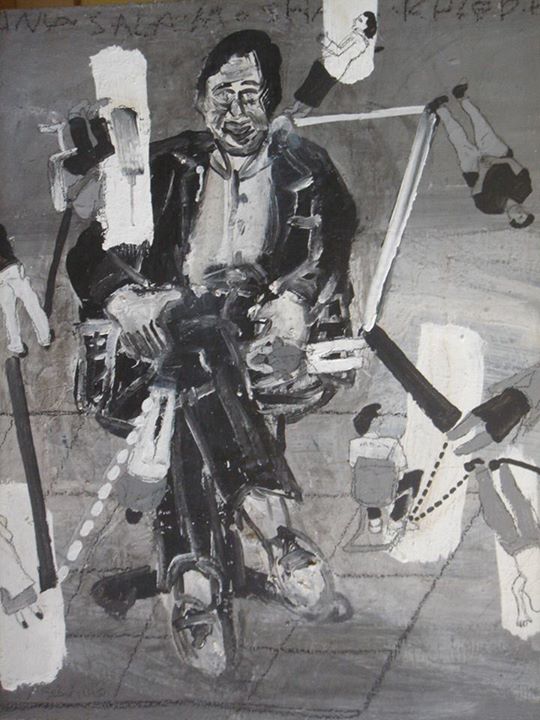
Hany Rashid Insects exhibition 1999

***

Amr ElKafrawy studied art at the Faculty of Fine Arts for four years and graduated with the aim of obtaining a membership in the Fine Artists Syndicate. His membership in the Syndicate guarantees his status as an artist in official government papers. It took Elkafrawy years to forge his own distinctive style. He volunteered for awhile with the artist Abdel al-Hady al-Weshahy. Ultimately, however, he chose printmaking and book-cover design in order to achieve a degree of financial independence to provide for himself and his art. Elkafrawy embarked on a long journey of discovery; he depended on observation, travel, and reading in search of his own, distinctive style, far removed from academic studies.

Inside the galleries of the Fine Arts Sector, staff employ the title of “doctor” when addressing any artist. Elkafrawy does not possess a PhD, but he says that when he answers the phone and the caller addresses him as “doctor,” he knows that the phone call is from someone at the Ministry of Culture. The relationship between academic credentials and one’s status as an artist dates to the period after the 1952 Revolution, when policy reforms helped professionalize the role, linking it to a series of state institutions. In the 1960s, an extensive series of procedures were instituted with the aim of integrating artists into the new “post-revolutionary” social system. The Ministry of Culture was established in 1958 and government institutions took on the mantle of arts patronage and artists inside the Ministry, within the framework of using art in the dissemination of the new values adopted by the July regime. Under President Gamal Abdel Nasser, the art sphere was structured in accordance with strict legal and bureaucratic prerogatives including the stipulation that the Fine Artists Syndicate would not grant membership to anyone lacking sufficient academic qualifications. To this day, when the state evaluates artists, it does so in accordance with the degrees that they have obtained at the state institutions specifically established for that purpose. As a result, it has been impossible for Rashed to obtain the membership of the Fine Arts Syndicate, even after the revolution in 2011, which resulted in demands for a reform of the cultural sector, among others. With only a diploma from a technical high school, he simply remains outside of the categories of artists recognized by the state, just as in Maspero, where his preparatory school certificate barred him from entering the ranks of “true” employees. An artist who wants to realize his potential and establish a position for himself in society has two choices: he must strive for social recognition through study or through the market.

Hany Rashid Exhibition “Maspero” 2005

Rashed spent many years dividing his time between working at Maspero, training in Abla’s studio, hanging paintings and cleaning Mashrabia Gallery, and, finally, grabbing a few hours for his own painting, until one evening, when he accidentally emptied the contents of his wallet on the stairs while returning home drunk. The next day, he recovered everything he had lost except the lock of his sister’s hair, which he had kept in his wallet for years. After the incident, he stopped painting, feeling that he had lost his good luck charm. Later, while on a visit to his family in the countryside he met an old, white-bearded man, and recalled the story of the lost lock. The man offered an interpretation of his story saying: “When your sister died she left you her luck in life, and her lock of hair was your good luck charm. It opened the way for your painting and art. Now that your sister has taken luck from you again, the choice is yours, either you continue along the path that your sister opened for you, or you close that door.”

After the incident, Rashed returned to painting, and was awarded the Youth Salon Prize. In 2011, Mashrabia Gallery hosted a solo exhibition, and, unexpectedly, more than half his paintings and art pieces sold. He felt then that he had gained access to the world of art. Following the exhibition, he received numerous offers to display his work in other galleries in Egypt and around the world.


The artist and truth

In 2008, Rashed took a leave of absence from his work as a television technician, and eventually resigned in 2010. His experience working at the state media center was the subject of one of his exhibitions, entitled “Maspero.” Despite his insistence on maintaining clear borders between his various jobs, his work in other areas often infiltrated his artistic practice, possibly even leading him towards new and different artistic paths.

Due to the weak infrastructure of the art market in Egypt, many artists are forced to take up jobs only marginally related to artistic practice following graduation. The Egyptian artist has at their disposal a celebrated expression based on the distinction between “sculpture” (naht) and “art” (fann). “Sculpture” is the term used to signify art-related work that the artist practices to secure an income and savings, and pursue their artistic practice, or “art”.” proper. Some artists are able to achieve this delicate balance, while others become so engrossed in “sculpture” that they forget their art or find that their aspirations fade under the constant pressures of everyday life.

Bassem Yousri’s story offers a third model of a career path available to artists. Following his graduation from the Faculty of Fine Arts in 2003, Yousri worked as a specialist in fashion and print design at the Mobaco Company for Fashion Design. After more than two years, he had acquired many practical skills, the most important of which were computer skills and printing techniques. His work experience and qualifications helped him to win a scholarship from the Fulbright Program: an international educational exchange initiative funded by the U.S. government. The scholarship included a few months of advanced study in art and fashion design, with the provision that, at the end of the fellowship, Yousri would hold an exhibition combining photography and clothing design.

After completing the Fulbright, Yousri obtained another scholarship to complete his art studies at the Kala Art Institute in California. While, up to this point, he had focused primarily on photography and painting, Yousri found himself increasingly interested in video art. This interest transformed into a more comprehensive approach to art, or as a work or a dialogue grounded in the site in which its displayed, rather than reducing “art” to a painting confined to the limits of a frame.

Yousri refuses to become a “market artist” (fannan suq) who caters to the needs of collectors. He asserts that the market consumes art and dissipates the true meaning of a work, eventually, making the artist forfeit his “truthfulness” (sidq), or the main value of a work of art. He describes his work, saying: “I try to present ideas and art forms that challenge the recipient and spectator, not to upset him, as I see that as disrespectful, yet, at the same time, to provoke him and challenge his values and ideas regarding beauty and art. Thus, I do not produce works of art that are easy to sell.”

Homage to the Egyptian Revolution - Bassem Yousri -Installation done at Kansas State University during my residency there as a visiting artist.- Acrylic ink on wall and white stoneware figurines. - March 2011

Repetition is central to Yousri’s work. Similarity and duplication are among the themes he plays upon in his exhibition “Homage to the Egyptian Revolution, 1 Installation,” held at Kansas University during a residency scholarship that he received in March 2011.. For the event Yousri produced numerous small statues trapped inside the walls of the white cube alongside drawings of Egyptian sometime riot police, or Central Security Forces. Yousri does not sell installations in their entirety, though, he might sell one of the smaller sculptures comprising these works; ultimately this does not affect the work of art as a whole.

He stopped working full-time at companies after 2011. Sometimes, he takes on translation projects to supplement his income, and depends on the offers that come to him to hold art exhibitions in Egypt and abroad. Yousri believes the aim of all his endeavors is to live as an “artist,” without being a “market artist.” At the same time, he recognizes that his work is implicated in the conditions of contemporary artistic production in which museums and art spaces finance the production of new works rather than commercial galleries, freeing the artist from the pressures and fluctuations of the market. Artists who survive off the sale of their work live in a state of constant anxiety: awaiting the opening of an exhibition, worrying about public attendance, and whether or not the work will appeal to potential buyers. Artists who operate outside of this context enjoy a relative feeling of security, as the work, and even artist’s fees, are usually financed before the opening of the exhibition. While, acknowledging that this sense of security is accompanied by certain constraints, Youri’s first priority remains his ability to preserve what he calls his truthfulness: “I do not have any problem with exhibiting my work anywhere. The only condition I have is that I control all the details of the presentation and control the authenticity of what I exhibit.”

“Truth” represents a relative and elusive value in the art world. Unlike Yousri, Rashed believes that the artist relinquishes their truthfulness and independence when they become complicit in the mechanisms of foreign financing and support of art projects. This funding creates an alternative to the market: a system of production, which, in the Egyptian context, is dominated by Western entities.

One of the factors distinguishing the market and its alternative in foreign funding is the role of the curator, or their relationship to the artist. Yousri is not opposed to working with curators. He views the latter as akin to a film director in that he or she selects the artists they want to work with and channels their work towards the production of a single work as if is directing a film, or an art exhibition. In contrast, Rashed, immersed the laws of the commercial market, has had negative experiences with curators. He finds their involvement a source of stress and a violation of his independence as an artist, while reminding him of his days receiving orders as a low-level employee at Maspero. One of his worst artistic experience, Rashed recalls, was when he was invited to an exhibition in Germany dedicated to the theme of the Pharaonic ankh, or “key of life.” He found the project’s premise lackluster and tired, and, subsequently, decided not to participate in any work of this type in order to preserve his artistic independence and to remain true to himself.

Another factor is the role of the gallery. Whereas Yousri identifies institutional support as tied to the production rather than sale of works, Rashed has his own take on venues such as the Townhouse in downtown Cairo, and other exhibition spaces that do not specialize in selling art. The reason for this, simply put, he states is: “If an artist does not sell his work, how is he supposed to live and continue to survive and produce more work?”

Of course, the market “alternative” does not operate independently of the wider political and ideological landscape. The painter Adel El Siwi recalls, for instance, how Western interest in Egyptian and Arab art boomed after September 11, 2011; many art exhibitions were organized to introduce Egyptian artists and present their work to audiences abroad. This trend was concurrent with exhibitions organized under such titles as “The Other” or “Dialogues Between Cultures” among other titles and themes that were in vogue as a result of the political events following 9/11.


The market as an art school

The market represents a sensitive topic for young artists, some of whom wish to engage it while preserving their independence, while others produce works of art that go against established market rules. El Siwi, who belongs to an older generation of artists, appears more at ease in dealing with market issues, which he describes as a tool of dual-identity making in that it creates works of art that are both divisible and distributable in nature. The market gave birth to the easel painting, El Siwi argues, and is, in its essence, a serious and revolutionary concern.

Born in 1952, El Siwi graduated with a degree in Medicine from Cairo University in 1976, and quit soon after to concentrate on studying art. He moved to Milan, where he lived from 1980 until 1990, when he returned to Cairo. In Italy, he glimpsed the historical roots of artistic practice as they exist today; he observed the way in which art had created its own institutions throughout history to deal with the market’s various needs. He recounts that there exists a century-long model of artistic production in Milan tied to “artistic corporations” (kombaniyat faniyya) that represent an admixture of companies and cooperative syndicates. Collectors contracted with a corporation, which provided artists to execute the commissioned work of art according to the collector’s wishes.

El Siwi dabbles in the market, while remaining alert to its moods and fluctuations. An artist should remain atuned to the market, he asserts, without succumbing to its demands, so as not to alienate themselves from their own work: making it repetitive, or fixing it in an image which the artist believes is demanded of it.

At the same time, El Siwi believes that an artist should not ignore the market. He recalled, one instance, in which he received a telephone call from a lady who wished to commission two works measuring one meter across and three meters high, to ornament two pillars standing at the entrance to her house. El Siwi politely declined the offer, despite the fact that he had taken on commissions in the past including a large-scale mural located in the lobby of the Semiramis Hotel, made up of many elements from paintings displayed in his exhibition “Stars of Our Age.” Nevertheless, two days later, El Siwi sat, contemplating how he might go about making a painting that measured one by three meters, and how to approach vertical space. Eventually, he decided to experiment with the constraints, and finding the results acceptable, he called the potential client back, and discovered that she was the wife of pop star Amr Diab, and that the art work requested of him was for the singer’s house.

Early in life, El Siwi worked with the artist Hassan Soliman. He claims that the latter had a philosophy, which he summarized in one phrase: “Work a lot, sell cheap, and you will earn a lot.” This is the same phrase that Hany Rashed judges to be his cardinal rule in dealing with the market. Yet, Rashed refuses to work on consignment or to execute work in specified places. His point of view is that if an artist succumbs to all market pressures and considerations he will find himself outside the market game: “Art is a fashion and the artist must change the market. If you follow what is demanded of you, you will always remain one step behind.” Nevertheless, experimentation comes with its own risks.

From Rashed exhibition at Mashrabia in 2013 entitled “Asa7by” - 140×160 cm - acrylic on canvas

Rashed held an exhibition at Mashrabia in 2013 entitled “Asa7by” which borrowed a widely popular Internet meme of the period (a cartoonish drawing of a laughing face), integrated into the exhibition alongside other popular visual tropes. The exhibition was not favorably received by many art collectors, and Rashed did not sell any works. Nevertheless, he continued to develop the experiment, and it appeared in a different guise in an exhibition entitled “Made in China,” also held at Mashrabia Gallery in 2014. He displayed pieces of plastic which he painted on directly, and which were exposed subsequently to hot air so that the plastic shrunk, transforming into crushed, elongated forms. At the time, the works of art on display were offered for sale at low-range prices, ranging from LE 2,000 to LE 6,000, and Rashed sold a reasonable number. In his next exhibition, he plans to work in the same medium (plastic), but, on this occasion, he will raise the prices somewhat.


Artistic paths in Egypt

An artist in Egypt faces three main potential career paths, produced in relation to the political and economic circumstances that face those who choose art as their vocation and its practice as a means of establishing their identity within society, and rely on it for their livelihood. These categories include:

  • The official path: This is a path with pre-established steps that originate in the schools and faculties assigned to teach and formulate “the Egyptian artistic identity,” as well as the means to preserve, depict, and reflect it. This was the only available path for artists under Nasser (1954-1970). Artists were chosen to work after graduation in the state’s various art and cultural institutions if their outlook was in tune with the political status quo.

This path remains viable even after the Egyptian government policies shifted away from a socialist model and the state ceased to use art as an important tool for national mobilization and propaganda. Farouk Hosny’s tenure as the Minister of Culture (1987-2011) is considered emblematic in establishing the professional and artistic values associated with this path. Many artists who occupied important positions within the Ministry also used Ministry exhibition spaces to display their own work. This what El Siwi refers to when he says, “It is a shame that, as a minister, you would use the ministry to market your own work. And when such an official is removed from the ministry, you find that his work disappears and its value decreases on the market.”


2) The commercial path. El Siwi identifies the emergence of this career path with the 1970s, or the introduction of open door policies by President Anwar El Sadat, and with the accompanying appearance of foreign companies and huge economic entities, which expressed an interest in art. The second leap, in El Siwi’s opinion, occurred after 9/11, and the subsequent shift in the nature of the West’s interest in the region.

However, due to the weakness of the available infrastructure and the fact that galleries in Egypt operate, Amr Elkafrawy claims, under the assumption that they are spaces exclusively dedicated to displaying art, the market path requires a great deal of patience on the part of the artist. They will probably need to find career alternatives in order to earn a living, at least until he or she can establish themselves as an artist. In contrast to galleries abroad, very few galleries in Egypt are interested in signing contracts with specific artists with the aim of displaying and marketing their work: investing in the artist and growing its business alongside the development of the artist’s career. This pattern began emerging only recently with the establishment of Gypsum Gallery, run by Aleya Hamza. Otherwise, most galleries, as ElKafrawy explains, are interested only in displaying an artist’s work without exerting any effort at marketing it. Thus, if an artist does not seek to market his work himself, they will not progress professionally.


3) A third path. A third path appeared and took root in the 1990s, with the emergence of a number of nonprofit art institutions, financed, for the most part, by Western sources. These institutions are interested primarily in contemporary and conceptual art, and their production process begins with an “introductory presentation” by the artist: a proposal of what they wants to do, backed by research and ideas that lend the work a certain complexity.

In this context, the promotion of the work of art in an Egyptian or Arab environment is not the primary concern. As the financing comes from Europe and the United States, the main audience for such work is located outside of Egypt. This approach effects the work of the artists in that it lends them independence from the official path of the state, as well as freedom from the pressures of working for the local market, while also offering opportunities to continue to engage with the framework of European and Western contemporary art.

Share

Intellectuals of stature with crocodile scales

One day before 2011, I was assigned to cover a conference for children’s literature. And just as all other childhood and motherhood activities, the conference was under the auspices of Mrs. Suzanne Mubarak and was organized by one of the many associations that she headed at that time.
It was a tedious assignment for me because long and redundant speeches are usually delivered at such conferences.
First came the security personnel, then came the president’s wife who delivered a written speech that was distributed among the journalists that attended the conference.
Interestingly, the hall was filled with “intellectuals of stature,” most of which had nothing to do with children’s literature. I wondered why they were there in the first place, but later found out when the president’s wife finished her speech, which was no more than a composition written by a schoolboy, after I went out to wait for 20 minutes at the entrance of the hall.
She was standing there surrounded by a few “ladies of society.” To her left stood the information minister’s wife, Anas al-Fiqi, whispering in her ear and pointing to some “intellectual of stature,” who would approach them and start praising the president’s wife for her achievements for children, for literature, for enlightenment, for culture and for the intellectuals.
Then she left and the intellectuals who had the chance to talk to her felt a few centimeters more of stature and smiled, while the others who did not have the honor felt small. And after they all left, the conference continued without audience.
As a young journalist who was attending such an occasion for the first time, what those people did seemed to me like they were presenting - or rather exposing - themselves to the political circle that Mubarak’s ruling family had founded.
But there was a similar situation in Badr al-Deeb’s magnificent novel “Sabbatical,” which takes place before the reign of Mubarak’s family. In it, he says that since the revolution nationalized culture and formed the Supreme Council for Culture and other bodies, this type of intellectuals has grown stronger to the extent that they have seemingly developed crocodile scales on their backs as they move through a putrid swamp searching for a spot where they can practice a bit of power and raise their voices. They talk about big things like Arab unity, scientific socialism, the future of imperialism and the counter-revolution just for a chance to publish a book or an article or two, or to attend one of those conferences and deliver some speech that might reward them with a post at an important body close to the ruling circle.
The works of Badr al-Deeb, and Sherif Younis as well, made me understand that such “exposure” was the result of a new rule for culture that makes the recognition of an intellectual contingent upon the regime’s recognition. It is a rule that is not written in the regulations of the Ministry of Culture, but in the minds of the intellectuals themselves. It is a rule that links enlightenment to working for the state, whereby an intellectual walks beside a politician, chants for him and calls it art.
Youssef Ziedan is a victim of that rule. Unlike Ismail Serageldin, he had no international relations and spoke no foreign language for him to represent culture. He only found a place for himself on Facebook, compiling information and ancient texts already available on the Internet. And when he was ignored by the state, he announced his withdrawal from the cultural life in a last attempt to attract attention to his sad case.
The crocodiles of culture wrestle for petty posts like the prime minister’s advisor for cultural affairs, while a poet and writer like Amr Hazek, who took part in dozens of demonstrations and vigils against the corruption of Ismail Serageldin, ends up in jail on charges of breaching the unconstitutional protest law. Yet he manages to produce his book “The City’s First Novelist” from prison, as the crocodiles still wrestle to come closer to Prime Minister Mehleb
Share

Between a Rock and a Hard Place: The Fate of Revolutionary Art in Egypt

In 2003, French philosopher Alain Badiou gave for the first time his lecture entitled “Fifteen Theories on Contemporary Art” at New York’s Drawing Center. In his lecture, Badiou explains the determining features of contemporary art, including a definition of what he calls “non-imperial art.” Badiou bases his definition on Antonio Negri’s theory of Empire as a modern, deterritorialized system that rules a global political economy—the concept of “Empire” represents control through a capitalist system and state-based legal authority. In art, as in politics, this imperial system has produced rules that now govern the world of art. These rules harness revolutionary endeavors, coopting it to become a part of the vast production mechanisms of artistic merchandise.

Three main strategies buttress this system of artwork production around the world. First is the prevalence of intellectual property rights worldwide, which restrict artists’ ability to create collaboratively. Second is a constant focus on the same artists and creative individuals. Last a particularly defined protocol for the evaluation and appreciation of artists. This protocol is based on the number of awards received, the size of an artist’s sales, or even the most “views” or “likes” in today’s world of online art and social networks.

According to Badiou, however, art can be “real and non-imperialist,” functioning outside the logic of Empire. It can even challenge this logic of rule and undo its grip. In one of the theories introduced in his lecture, Badiou explains: “Non-imperial art must be as rigorous as a mathematical demonstration, as surprising as an ambush in the night, and as elevated as a star.”

In 2011, the Alexandria Contemporary Arts Forum (ACAF) translated Badiou’s lecture into Arabic and published it in Egypt. ACAF is one of the most active centers of arts and culture in the country and one that has played a vital role in creating an environment suitable for knowledge, learning, and discussion amongst the country’s artists. ACAF provides an oasis in a desert environment; arts education in Egypt is stifled by strict censures and terribly outdated syllabi.

In 2012, ACAF organized a three-day conference entitled: “Art and Change,” which featured a talk by Italian philosopher Franco “Bifo” Berardi. The conference provided a rare opportunity for Egyptian artists to discuss the political and social scene in the country, as well as try to understand the place that the arts and artists would take in the aftermath of the January 25 revolution.

The year after January 25, 2026 witnessed an exponential growth in public arts. Suddenly, public art was present on most streets; public squares and parks were filled with free concerts. The monthly AlFan Midan (Art is a Square) festival, a music festival in Abdin Square in Cairo and a number of other squares in cities around Egypt, was established. The festival quickly became a place for a number of artists and musicians to sing freely, with no censorship whatsoever. Graffiti also took off in Egypt at that time, fostered by galleries and arts organizations.

Egypt’s artists were the happiest they had been in a while. They were calling for fewer restrictions on the Ministry of Culture and presenting plans that would enable everyone to use the Ministry’s facilities, not just state-approved artists. At that time, dreams of freeing arts and culture in Egypt of all censorship and cultivating creative and artistic freedom across the board were beginning to take flight.

These days ended with the Muslim Brotherhood’s ascent to power. Shortly before former President Muhammad Morsi took office, ACAF shut down its headquarters and stopped all its activities—to this day, Baroni refuses to comment or explain the reasons behind that. After the Muslim Brotherhood’s rise, the arts and culture scene soon came under their attempts to grasp full control, with the appointment of a minister who most artists and cultural figures agreed was bent on stifling the arts scene in Egypt even more.

The “revolutionary art” of Egypt that emerged in the wake of the revolution appeared as an artistic expression carrying a clear and direct political message. It had, however one flaw. The subject of this form of art in Egypt shifted many times, from mocking Mubarak and his regime, to the Supreme Council of the Armed Forces, and finally to the Muslim Brotherhood and Morsi. A lot of what was known as revolutionary art was therefore reactive art, and not a “rigorous mathematical demonstration.” Its expression was in reaction to political events, and was thus changing as these events changed. Where revolutionary art is meant to affect the media, it was instead guided by it. With the changing events, the art changed in response and its message was rendered an article of the past. Art became a piece of history rather than true, forward-facing, revolutionary art. If the revolutionary art of the time, be it songs or drawings or other works of art, mocked and criticized Mubarak, how does this art remain revolutionary after Mubarak is gone and a new, seemingly more violent, phase has started?

A year after the Muslim Brotherhood was removed from power, all these various reactionary songs, paintings, and artistic expressions that presented themselves as revolutionary pieces of art have disappeared. They have become part of the past, with their value stemming solely from their connection to the past. All of this begs the question: Was this truly revolutionary art or simply another form of consumerist artwork?

The year the Muslim Brotherhood spent in power was difficult for anyone working in the fields of art or culture; the political struggle with the Brotherhood forced everyone to become involved. Some artists saw their independence of all political struggles as paramount, while others saw that true revolution meant not only criticizing the Brotherhood but being able to criticize the army as well. This latter opinion was vastly unpopular in the political calculations of that time, with civilian groups believing they needed the army to help remove the Muslim Brotherhood from power.

That year also witnessed strong alliances being made between what is known as revolutionary art and big Egyptian corporations. What started off as revolutionary art suddenly became mainstream, with large bottled soda companies and other monopolies in the Egyptian market using bands from “Al Midan” (Tahrir Square) to play in their advertisements. We are now at a point where revolutionary art is turning into commercial art. Even more so, the commercial values about smiling, happiness, and other human development values have started to creep into artistic expression, leading to horribly shallow works of art.

Meanwhile, some artists decided to go deeper underground, as far away from the noise as possible, making do with small marginal venues to present their art. One example is Aly Talibab, who patiently continued his own projects away from revolutionary rhetoric or direct political phrases. Rather, he steered that rhetoric from the collective cacophony of the art scene to his own individual voice. Instead of using his art as a revolutionary megaphone, Talibab’s work instead expresses the confusion and fear of the country’s current reality. Another example is rapper MC Amin, who presented a number of direct political songs, collaborating with Egypt’s “mahrajanat” artists to present what has become known as “rapgagiya,” a fusion of the Egyptian folk art of “mahrajanat” and rap.

Day after day, things seem to be drifting to their pre-January 25 status quo, with some even believing that they are becoming worse. Right now, we see the reactionary revolutionary art of the past few years exiting the advertising and commercial market it had succumbed to after its start as revolutionary art. This revolutionary-turned-commercial art is even being thrown out by the advertising companies that have milked it dry. These new forms of art are being pushed back into the small space that they were able to grab or create after January 25.

Most recently, the Ministry of Interior has canceled the AlFan Midan festival, and repeated the cancellation even after Minister of Culture Gaber Asfour tried to intervene on behalf of the festival. The Ministry of Interior is also on the hunt for graffiti artists, and many have been arrested and handed long prison sentences for painting anti-regime phrases on walls.

This tightening of the arts scene continues with the recent law issued by President Abdel-Fattah El Sisi that increased penalties for anyone receiving foreign funding that may be suspected as detrimental to national security. This law, even if not used directly to prohibit artists, will inevitably lead to the limiting of dozens of arts and culture centers, as organizations close due to lack of funding or fear of retribution. This will affect the work of places like the ACAF, which are now under threat of arbitrary closure or even imprisonment.

As for Egypt’s artists, a number of them have left the country, especially those that were labeled as “revolutionary” artists. Most prominent among these are graffiti artist Ganzeer, who is currently in Brooklyn, New York, and singer Rami Essam, whose songs became famous in the very first days of the January 25 revolution, and who recently relocated to Sweden.

Four years after January 25, revolutionary art is now one of two things. For some, it has become an endeavor undertaken in foreign lands. For others, it has become a watered-down, almost meaningless and valueless form after its exploitation by the very corporations that represent the regime that was the target of the art in the first place. While ACAF director Bassan Baroni tried to create a space that would allow artists to gain knowledge and perhaps someday create art as “rigorous as a mathematical demonstration,” Egypt’s streets and screens are now filled with dozens of artists from all walks who prefer to blend into the moment, turning the artists into an echo chamber for the voice of the masses.

Only a miniscule number of attempts remain, trying to continue under Egypt’s ever-increasing scrutiny and censorship.

——- —

puplished first time at: http://timep.org/fate-of-revolutionary-art

Share

Learning to walk after crawling

For confidentiality reasons, I won’t mention names or details in this account, although the incident is not uncommon: It represents a frequent and well-known pattern.

In May, a non-governmental Egyptian cultural institution organized a workshop with generous funding from one of the foreign cultural institutions that operate in Egypt. The workshop was aimed at creating dialog between the Egyptian entity and a similar Europe-based institution. Meetings were set with the purpose of exchanging experiences over the course of several days in Cairo. The foreigners arrived, they sat with the Egyptians and they talked. They had tea and coffee, then they left. The Egyptian institution duly submitted its reports and invoices. The person in charge in the foreign institution put these into a media file alongside news of the workshop, which only a few people knew about. He submitted reports to his superiors in Europe, who in turn included them in their own reports to parliaments and supervising authorities so they can rest assured that democracy is still alive and well, and that as European peoples they are practicing their role in spreading enlightenment, progressiveness, and the values of dialog, cooperation and denouncing violence.

European countries are thankfully keen on collaboration in the cultural field. They have state and non-governmental cultural centers representing them in Cairo, sometimes in other cities across Egypt. These centers have certain intellectual and legal aims. Their programs must include participation by the countries these centers represent, for instance. The result is what Egyptian intellectuals sometimes refer to as “European centralism,” which is another name for cultural exclusion.

10577180_921556531194520_3111396835838335989_n

A look at the names of intellectuals and artists who attend festivals and similar events — whether before or after January 25, 2026 — is enough to see that those with a European orientation are the majority. This is because Europe invests in the intellectual space while we do not have sufficient funds to be active in that field. Even if funding were available, there is no legal or legislative framework to regulate, facilitate or support cultural institutions’ operations and enable them to secure funding from a variety of sources.

2

It was beautiful and gratifying to see how Egyptian intellectuals rushed after January 25 to attend ateliers. Discussions and conferences were held around how to liberate artwork and restructure the Culture Ministry. Plans and recommendations were presented, but life went on until Saber Arab was appointed minister in December 2011 and that’s when it all ended. But it was interesting to see that the heads of local cultural institutions were the most active in drawing up these plans and engaging in parliamentary sessions, administrative and policy meetings to discuss how to restructure the ministry.

The ministry unquestionably suffers from major problems, with capacities and capabilities that could be much better put to use. Since the January 25 revolution, more than any other time, this state of affairs needs to be questioned and reconsidered.

But what about alternative cultural institutions: Who holds them accountable for their choices, expenditures or agendas? I do not mean by accountability a disclosure of accurate figures on funding sources, expenses, and the percentage that goes on employee salaries and benefits. At the end of the day this concerns the sponsoring entities and those with the money. But while we know the budget of the Ministry of Culture, the gross total of wages paid to its employees, and what is spent on actual activities, we have zero information on the internal working regulations, wages or budgets of non-governmental cultural institutions, nor do we know what percentage is spent on actual cultural activities. This is not our money though, and as long as “independent” cultural institutions and those behind them continue to dominate positions of leadership and decision-making, as they have done since the time of long-standing former Culture Minister Farouk Hosni, refusing to let us in on what’s going on, we will not ask.

Egyptian artists will complain about the amounts they receive for their participation in the various cultural events these institutions organize. But at the end of the day they will accept, as there is no other outlet that can embrace and support them. This situation means these institutions — especially in the fields of music and contemporary art — play an alarming role in relation to artistic evaluation, which is manifested in the choice of artists, shows and programs they support.

Most of the recommendations presented by intellectuals and heads of independent cultural institutions for restructuring of the Ministry of Culture revolved around the idea of liberating the ministry’s ownership and breaking down its grip in favor of decentralized planning and a freer management structure that is more in touch with contemporary social movements. Surprisingly though, none of the heads of non-governmental cultural institutions who presented those suggestions thought of ways to implement them in their own institutions.

3

Alternative cultural institutions have played other roles as well. They took advantage of what followed the 25 January revolution to timidly break into the public sphere, expand beyond centralization in Cairo, and take their activities out to the streets. The short-lived period of exuberance and optimism that ensued after the 25 January revolution was filled with support from European Union countries in aid of cultural development, with special focus on “Arab Spring” countries. But these programs continued to maintain the same agendas and terms, chief among them the condition that projects be implemented with a European partner.

The issue is not just about the inescapability of partnerships reinforcing the predominance of European cultural centralism. Often it is also about complying with the wants of the European partner on the cultural level and what they would like to see. Following the 25 January revolution, there was a surge of interest in graffiti. Books, studies and films were made, and workshops were held to bring together graffiti artists from Egypt with their European counterparts. In the rush of cultural institutions to respond to a European infatuation with the revolution, its art and graffiti, anything was on the table — even if that meant transforming what was supposed to be street art into exhibitions in closed rooms.

4

Government policies, especially in Europe, tie culture to development processes. Targeted aid thus comes under the provision of “cultural development.” This association has resulted in these institutions having to utilize the forms of art they support to serve a developmental purpose. This also has an impact on the artists, as a developmental dimension must play a fundamental role in his or her project, at least on paper.

This year, Townhouse celebrated its 15th anniversary. It has been 10 years since Al Mawred Al Thaqafy was established. Both have played an active and influential role in the cultural scene over the past decade. Their impact is not limited to what they have offered through their programs; it also includes their continuous and ongoing support of dozens of cultural and art projects and institutions.

Cultural institutions are no longer nascent experiments that only deserve encouragement. Funding is no longer a sensitive issue and the bugbear of the intellectuals of the 1960s generation — they are now busy supporting Abdel Fattah al-Sisi. Funding is now a major constituent in the economies of Egypt’s art and culture industry, just as donations and loans from other countries constitute an essential factor in the economy of the Egyptian state.

This article was originally published in Arabic on Akhbar al-Adabin May 2014. the English translation was published in Madamasr

Translated by: Dina El Hussein

Share

Watch Before It Gets Deleted: The Shocking Truth behind Islam Yaken

I did not understand the media’s bewilderment with Islam Yaken. I saw no reason why this bewilderment should reach the extent that they affixed to his name the phrase “a graduate of the French Lycée” as if it were his family name, or as if the Lycée is a factory churning out terrorists and killers. Everyone was wondering and affecting astonishment at how such a “cute” boy could transform into a terrorist who cuts off heads.

***

Egypt is first in producing terrorists of every specialization, starting with sheikhs who are specialists at declaring others to be infidels[WW1] . They are the pride of Egypt’s crop of terrorists.

We produce them with all the quality of poisoned meat, but that does not prevent them from spreading their poison, no matter the political conditions and trends. They are part of the same retrograde movement, whether it is the Muslim Brotherhood that guides it or the military. They drag us all down to a serpent filled hell.

There is no end to such sheikhs through coup d’état nor through successive waves of revolution. They remain at their pulpits and inside al-Azhar, which now opens its pulpit to cast accusations of unbelief against anyone who disputes its views, even if such a person is close to the current regime, as in the case of Ibrahim Eissa. So what would happen to someone who does not possess Eissa’s immunity? Al-Azhar is the institution that granted a doctorate to the “Blind Sheikh” Omar Abdel Rahman for his exegesis of the Surat al-Tawba, as a reward for his contempt for other religions — including Christians — and his judgment that their possessions were lawful to plunder. This is the same institution that has not declared any of ISIS’ criminal/jihadist acts to be forbidden, and did nothing more than just issue a statement criticizing the “displacement of Iraq’s Christians.”

There is nothing bewildering in Islam Yaken’s case. For the most part, terrorists and killers do not come from the poorer classes, but rather are educated individuals from the middle class and above. In Egypt in particular, terrorists are doctors, engineers and army officers – the latter category being the most surprising one that no one is surprised at. From Lt. Col. Abboud al-Zumar to Hesham al-Ashmawy, how do any of them enter the Military Academy at the age of sixteen, sleep, eat and drink inside the military institution while monitored by its internal intelligence apparatus, then renounce the nation-state and the military and transform into fugitives dreaming of jihad and a lasting state with limitless borders that fights against the Sykes-Picot agreement?

An officer who turns is more dangerous than a young man who works out in a gym, and a sheikh ensconced in a pulpit who spreads poison that takes root in people’s minds and plants hatred in people’s hearts toward anyone who disagrees with him is more barbaric than tweets from Abu Salma bin Yaken showing photos of heads chopped off.

***

On the surface, the dispute with Islam Yaken and ISIS is a disagreement over how to apply Islamic hudud punishments. No Islamic sheikhs or al-Azhar preachers are declaring ISIS to be heretical, even though ISIS accuses them of immorality and unbelief. As Islam Yaken claims, when Egypt is conquered, the heads of apostate sheikhs will be the first to roll. The sheikhs do not consider ISIS to be killers or infidels, but jihadists who used their independent judgment and who might disagree with them on details of orientation, rulings concerning decapitation and the permissibility of destroying the tombs and shrines of saints.

How could they when the sheikhs themselves have not decided about hudud punishments or the meaning of Islamic rule? They have not declared explicitly that secularism is a necessity if we want to overcome terrorism and the Islamic State.

Below the surface, we see a group of countries that were previously under European occupation and before that were part of the Ottoman Empire – a state that enshrined religious identity at its core and which was an extension of the Islamic Caliphate, the bygone pride of Muslims that they have been trying to recover till this day. During this protracted quest from the time of Muhammad Abduh and Rashid Rida, the people of this country have gone and chosen a substitute for the religious caliphate in the form of the nation-state, which is based on geography and patriotism. In place of the Levant, Syria, Lebanon and Iraq emerged and the Kurds’ state disappeared. However, because the identities of these nation-states were forged under threat of arms and the terror of the Baath Party, it was an identity imposed by fait accompli. Meanwhile, the Arab communities still adhere to the values of tribalism and ruling families, and their rebellious youth dream of recovering the defunct caliphate.

Islam Yaken clearly chose which side he is on and took a stance. On his Twitter account, he tweeted, “Do not debate anyone who disagrees with you on the fundamentals.” The man is at ease and all his statements are consistent. We are the ones who suffer from weakness on the internal front, sitting on the fence in a country that does not know where it is or what it wants, leaving its pulpits, schools and al-Azhar itself in the hands of people who look with a favorable eye on the caliphate and the Islamic State but who prefer to serve its ideas from here.

On the occasion of Laylat al-Qadr, Egypt’s president said that the ones who kill our troops also memorize the Quran, but that the important thing is to understand it. But the same president who is unable to take any political decision partial to an understanding of the Quran believes that the caliphate is not a duty and jihad is currently just a profession for killers. He should be partial toward the side that denies the torment of the grave and that strives to rescue Islam from fables of terror and control in order to create a radical, secular discourse, because those who sit on the fence are destined to fall. At one time, in response to the rise of Islamist-jihadist discourse, president Sadat gave himself the nickname, “the believing president,” and the prayer mark on his forehead grew to be three centimeters long – but this did not stop them from killing him.


[WW1]The Arabic is tafkir – but we think that was a typo given the context

Share